




How Does a Granulator Work in Organic Fertilizer Production?
A granulator in organic fertilizer production works by applying mechanical force—pressure, friction, or agitation—to bind powder or semi-wet organic material into compact, uniform pellets. The organic fertilizer granulator takes fermented raw inputs such as livestock manure, crop residues, or composted sludge and shapes them into marketable granules ranging from 2 to 10mm in diameter. This process improves product density, reduces dust, extends shelf life, and meets commercial packaging standards. Moisture content, particle size, and forming pressure are the three primary variables that determine granule quality and production efficiency.
Understanding the Basics of Organic Fertilizer Granulators What Is an Organic Fertilizer Granulator?
A mechanical device called an organic fertilizer granulator is used to press or clump together treated organic materials into thick, even pellets. It takes fermented materials like animal manure, straw, biosolids, and peat and shapes them by applying pressure or centrifugal force. The result is a uniform grain that doesn't cake up when shipped and spreads out evenly in the field. Granulation is the step that turns a low-value powder into a retail-ready product with a higher selling price for medium-scale producers who want to sell to businesses.
Common Granulator Types Used in Organic Fertilizer Plants
The revolving drum granulator, the flat die granulator, and the extrusion (roller press) granulator are the three kinds that are most often used to make biological fertilizer. Each type works best with a different kind of raw material and for a different production. Rotary drum granulators are good for wet materials, flat die granulators are good for flexible organic materials, and extrusion granulators make high-density crystals with low moisture inputs. It is very important to match the machine type to the material you are using. If you choose the wrong type, you will get bad granule formation, high return rates, and lost energy.
Wet vs. Dry Granulation Workflows
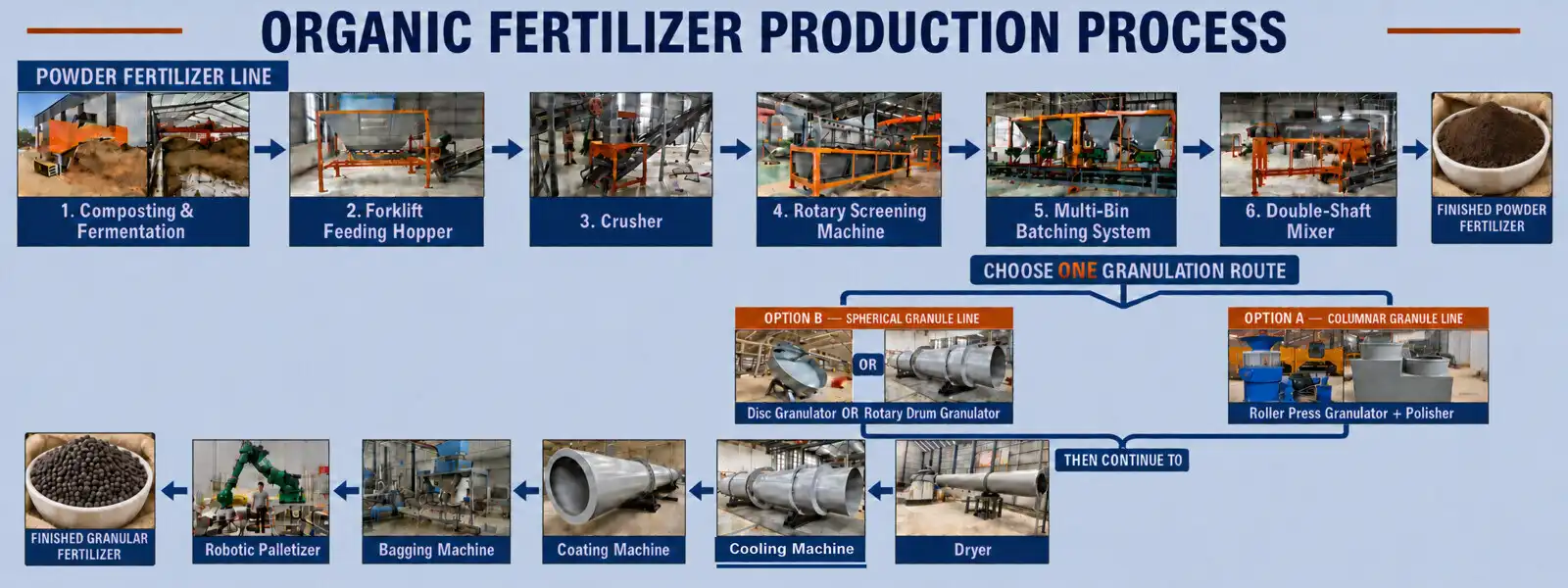
Wet granulation adds water or binders to the feed material, which helps it stick together in a drum that spins or a chamber that stirs. Usually, a dryer further downstream is needed to lower the final wetness level. Dry granulation, which is done in extrusion machines, pushes down on materials without adding liquid, using only pressure to make pieces. Dry methods work best with lower amounts of moisture (15–30%) and can sometimes be used instead of dryers, which saves money on energy costs. The steps in each cycle are very clear: raw material → conditioning → granulation → screening → drying (if wet) → cooling → packing.
Key Components and Technologies in Organic Fertilizer Granulators
The Granulating Chamber, Rollers, and Dies
The granulating chamber is where the material changes form. Two wheels that spin counterclockwise in extrusion machines push material through die holes and shape pellets under a lot of pressure. The hardness of the die and roller surfaces directly affects how dense the pellets are and how smooth the surfaces are. As a point of reference, HRC55–60 high-manganese steel dies usually last 1,500–2,000 hours of use before they need to be inspected. Granule crush strength is also affected by how hard the components are. Well-formed pellets should have more than 15N of crush resistance to stay together during shipping.
Feed Systems, Motors, and Control Units
A good feed system makes sure that the material flows evenly into the granulating zone of an organic fertilizer granulator. When feeding isn't even, the size of the granules changes and the rollers wear out faster than they need to. The motor drives the whole forming process, so it's important to choose the right power rating for the capacity you want to reach. The YXJY-55 Extrusion Granulator from YUXING has a 55kW motor and can produce 3–6 t/h of material. The granule sizes range from 2–10mm, and the forming density is 0.8–1.2 g/cm³. These are all perfect for medium-scale commercial production.
Integration with Downstream Equipment
It is not possible for a granulator to work by itself. After the material is turned into granules, it goes through a vibrating screen to get rid of any particles that are too small or too big. These particles are then sent back to the granulator feed. A rotary dryer lowers the moisture level to the right level (usually below 14%) for bagging, and a cooling unit lowers the temperature of the pellets before they are packed. Before starting to make something, producers should plan the whole line, including the granulator, screen, dryer, cooler, and bagger. This way, they can avoid expensive changes later on and get regular output that fits with when the market delivers.
Comparing Different Types of Organic Fertilizer Granulators
Rotary Drum vs. Extrusion Granulator
The rotary drum granulator grinds materials by spinning a wet cylinder inside it, which makes the particles stick together and form round pellets. It works well with feedstock that is high in moisture, but it needs a drying stage and a lot of floor space. The extrusion granulator uses roller pressure to push dry to semi-wet material through shaped dies. This makes thicker, more uniform pieces without adding water. The extrusion method allows for better control of granule size and lower drying costs after granulation, which is useful for producers who don't have a lot of floor space or use organic materials that are low in moisture.
Flat Die Granulator vs. Ring Die Granulator
Material is pressed between a flat die plate and a wheel in a flat die granulator to make cylindrical pieces. They work well with small to medium amounts of plant materials that are flexible. Ring die granulators push stuff through holes in a spinning cylinder-shaped die, making round pellets that are always the same size and shape at a faster throughput. Ring die machines work better for output goals of 3–6 t/h and make pellets that are the same length and mass all the way through. Ring die and extrusion types usually meet the quality standards of the market better than flat die configurations for business makers who package fertilizer for retail sale.
Wet vs. Dry Method: Environmental and Process Considerations
Wet granulation uses more energy because it needs to dry more, and it makes more exhaust air that needs to be cleaned. When used in extrusion machines, dry granulation makes very little leftover water, requires less process heat, and keeps the microbes active in bio-organic fertilizer uses. According to research, keeping the granulation temperatures below 60°C protects the good microbes that are mixed into organic fertilizer. This is an important thing for biofertilizer makers to think about because the vitality of the microbes directly affects how well the product works and whether it meets the label requirements.
Maintenance Tips and Troubleshooting for Organic Fertilizer Granulators
Routine Inspection and Lubrication Schedule
Your production investment is safe when you stick to a regular maintenance schedule on your organic granulating machine. During weekly checks, the temperature of the bearings should be recorded, the tightness of the belts should be checked, and the roller surfaces should be looked at for wear. Full greasing of the drive parts, checking the gear oil level, and cleaning the feed bin liners are all things that need to be done every month. To keep pressure from building up, die holes should be cleaned of caked-on material at the end of each production shift. Unplanned downtime can mean big daily output losses in medium-sized operations (3–6 t/h) if it isn't fixed. Scheduled maintenance cuts down on this.
Troubleshooting Common Issues: Clogging and Inconsistent Granules
When material gets stuck in the granulating zone, it usually means that there is too much wetness. When you put water into an extrusion granulator that's higher than 30%, paste-like material gets stuck in the die. Most blocking problems can be fixed by lowering the feed moisture or speeding up the rollers. Granules of different sizes usually mean that the feed flow isn't even or that the die holes are worn out. Granule regularity can be restored by checking the feeder screw for wear and replacing any broken die parts. Keeping a record of when adjustments were made and what happened helps workers find patterns more quickly.
Spare Parts and After-Sales Support
Getting real wear parts from the maker of your original equipment (OEM) stops fit and hardness mismatches that speed up damage. YUXING offers a lifetime 7x24 after-sales service that includes help with fitting, help with operation, and advice on extra parts. Because the YXJY-55 is CE and ISO certified, buyers from other countries can be sure that the parts are standardized and that the product meets all the rules. The online video commissioning help that YUXING offers as part of its regular service package is especially helpful for producers in Africa, Southeast Asia, and South America.
How to Choose and Procure the Best Organic Fertilizer Granulator
Match Capacity and Material Specs to Your Production Line
Make sure that the granulator's stated capacity matches your upstream output before you buy it. A machine that can handle 3–6 t/h can't make up for a line that can crush and mix 8 t/h; the bottleneck will stop the whole line. The YXJY-55 can handle lengths of material up to 20 mm and works with a moisture range of 15% to 30%. This gives workers the freedom to work with different types of material at different times of the year without having to change the equipment.
Evaluate Certifications, Supplier Track Record, and OEM Options
The CE and ISO certifications show that the machine meets international standards for safety and performance. This is usually a must for getting goods into many markets. In addition to certificates, you should look at the supplier's shipping times, ability to make changes, and service reach in your own country. Over 50 countries have hired YUXING, and they offer OEM options such as custom voltage settings, PLC controls, and labeling with your company's name on it. Products that are standard are shipped from stock, but units that are made to order take 15–20 days to arrive.
Budget Range and Total Cost of Ownership
The price of the equipment is one part of a bigger cost equation. Take into account the cost of installation labor, local freight, spare parts inventory, and the amount of energy used per ton of output. The extra cost of electricity for a 55kW machine that runs for 8 hours a day at $0.10/kWh is about $44 a day. Over a 300-day work year, that's $13,200 in power costs alone, which means that motor economy is a real financial factor in getting things. Before making a final choice, ask each of the chosen suppliers how much energy they use per ton of output.
Conclusion
Granulation makes low-value organic powder into a product that can be sold and is ready to use in the field. The process works with controlled moisture, mechanical pressure, and equipment that is perfectly matched. Each of these factors affects the final granule's size, density, and durability. Choosing the right pelletizing machine for your feedstock, capacity, and range of moisture levels will determine whether your production line makes money or has trouble with inconsistent output. The YXJY-55 Extrusion Granulator, an organic fertilizer granulator from YUXING, is designed for medium-sized producers who need a machine that can reliably and legally process between 3 and 6 t/h with little downtime.
Frequently Asked Questions
1. What moisture content works best for an extrusion granulator?
Extrusion granulators perform well with input moisture between 15% and 30%. Material below 15% moisture may not form strong bonds; material above 30% can cause jamming at the die.
2. Can I adjust granule size during production?
Yes. Granule diameter is adjusted by changing the die hole size and modifying feed rate. Some machines also allow spindle speed adjustment via a variable frequency drive (VFD) for finer control.
3. How long do roller and die parts last?
High-manganese steel rollers and dies typically require inspection every 1,500–2,000 operating hours. Replacement frequency depends on material abrasiveness and operating conditions.
4. Does granulation affect microbial activity in bio-organic fertilizer?
Yes. Extrusion granulation is a cold process. As long as process temperatures stay below 60°C, most beneficial microbial populations remain viable. Elevated temperatures indicate excessive friction or incorrect moisture levels.
Partner with YUXING — Trusted Organic Fertilizer Granulator Manufacturer
YUXING has been making fertilizer equipment for more than 20 years and has customers in more than 50 countries. Our YXJY-55 Extrusion Granulator can handle 15% to 30% moisture inputs and can produce 3 to 6 t/h. It is CE and ISO certified and comes with lifetime technical support 24 hours a day, seven days a week. We have been making organic fertilizer granulators for a long time and can offer full production line options, fast shipping from stock, and unique configurations for your market. Get a price from our team right away by emailing yuxing@hnyxmachinery.com.
References
1. Rynk, R. (Ed.). On-Farm Composting Handbook. NRAES, 1992.
2. Fertilizer Manual. United Nations Industrial Development Organization (UNIDO) and International Fertilizer Development Center (IFDC). Kluwer Academic Publishers, 1998.
3. Schulze, D. Powders and Bulk Solids: Behavior, Characterization, Storage and Flow. Springer, 2008.
4. Pietsch, W. Agglomeration in Industry: Occurrence and Applications. Wiley-VCH, 2005.
5. Food and Agriculture Organization of the United Nations. Plant Nutrition for Food Security: A Guide for Integrated Nutrient Management. FAO Fertilizer and Plant Nutrition Bulletin No. 16, 2006.
6. Cakmak, I., & Yazici, A. M. "Magnesium: A Forgotten Element in Crop Production." Better Crops with Plant Food, Vol. 94, No. 2, 2010.

USER EVALUATE
Get your tailored fertilizer plant solution — contact us today.