




Fertilizer granulation machine: Overview and equipment selection
If you produce powder fertilizer and want to move into the granular market, a fertilizer granulating machine is the piece of equipment that makes that possible. This guide walks you through how granulation works, which machine type fits your production scale, and what to check before placing an order. Whether you run an organic fertilizer plant or a compound fertilizer facility at 4–7 t/h, the goal here is practical: help you buy smart and produce better.
Understanding Fertilizer Granulation Machines
A machine called a granulation machine turns loose, dusty powder into thick, uniform pellets that are easier to store, ship without getting mixed up, and spread out evenly in the field. Fine particles are held together in the core process by pressure, moisture, or a mix of the two until a stable granule forms.
How the Extrusion Process Works
When extrusion is done dry or partially wet, material is forced between two rollers that are spinning quickly. The pressure flattens the powder into thick sheets or cylinders, which are then broken up or cut to the right size. This method works best with materials that are 15% to 30% water. It makes grains that have a high forming density (usually 0.8 to 1.2 g/cm³), which means they are strong enough to be bagged and shipped long distances.
Disc Pelletizers and Drum Granulators
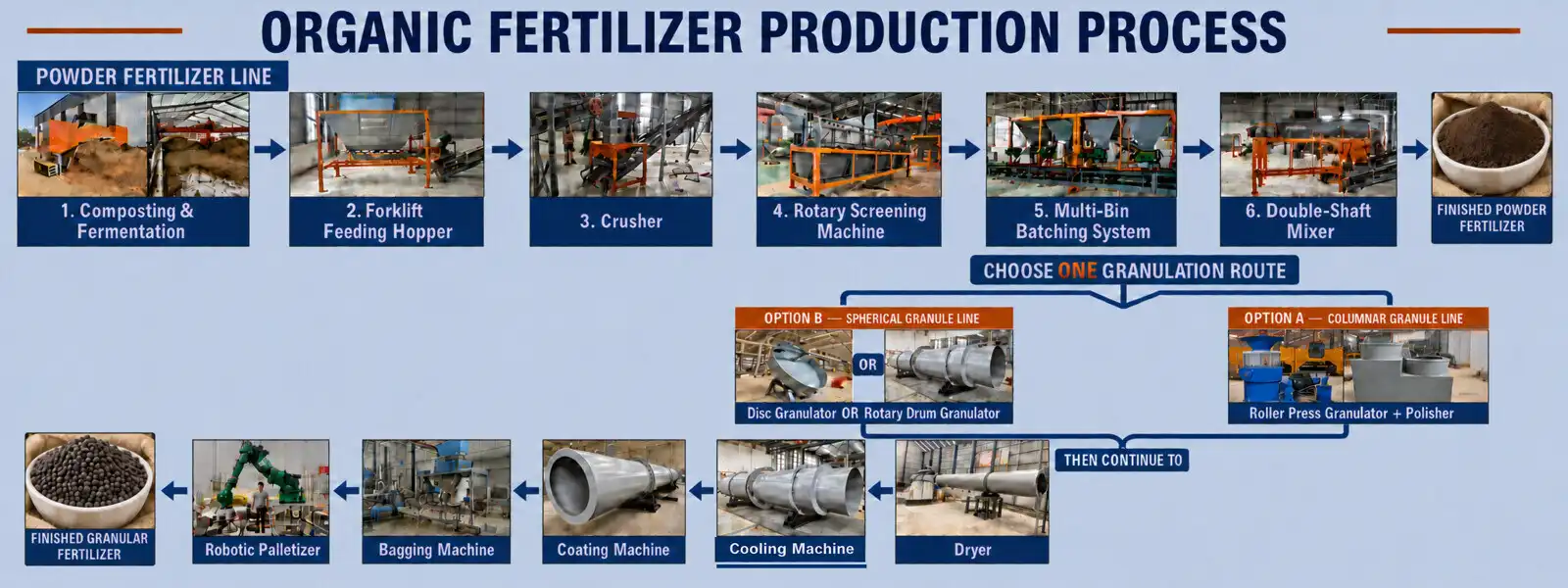
Disk pelletizers spin powder on a slanted disk and spray a liquid glue on top of it. The rolling action adds up to make spherical granules. Wet-agglomeration works the same way in drum granulators, but they can handle higher continuous volumes. Both choices work well for organic raw materials, but they need to be dried out after granulation, and the wetness needs to be carefully managed.
Why Granule Quality Matters Commercially
According to FAO market figures, granular fertilizer sells for 15% to 30% more than powdered fertilizer in most countries. Buyers in Nigeria, Vietnam, and Colombia always choose packed grain goods because they are easier to handle, last longer, and can be used with automatic spreaders. Changing powder to grains isn't just a matter of production; it's also a matter of making money.
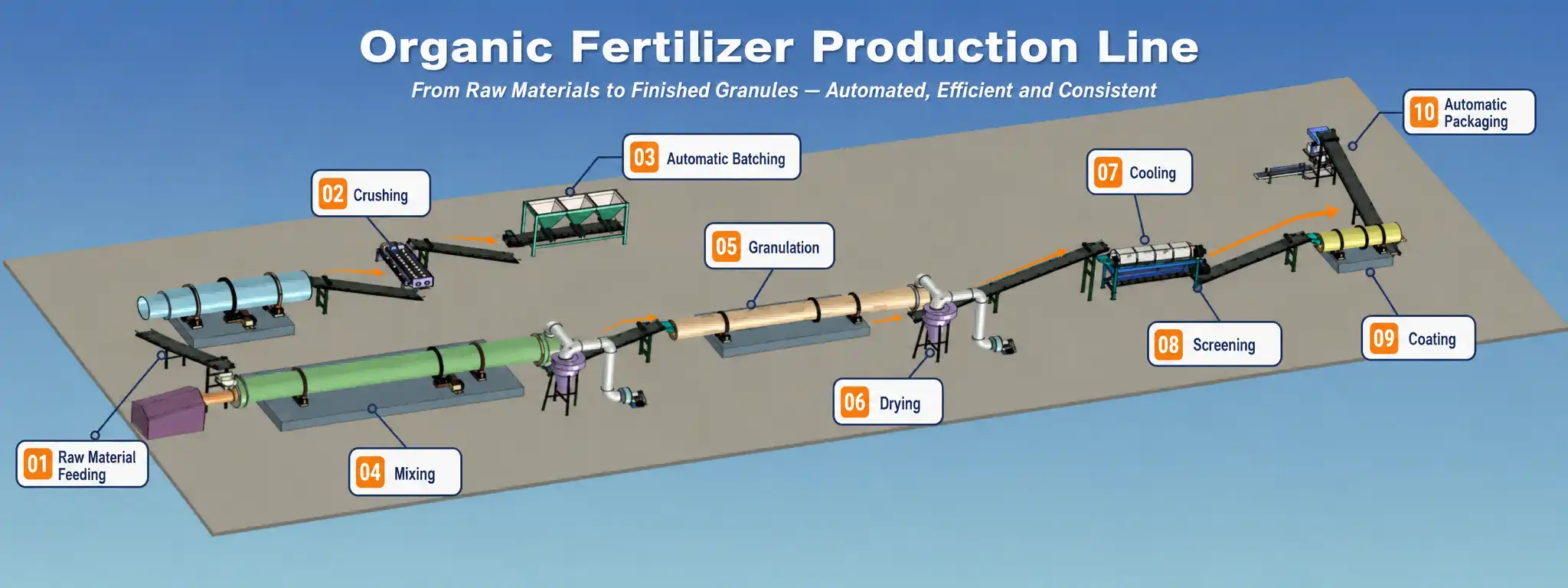
Key Factors to Consider When Selecting Fertilizer Granulating Equipment
If you pick the wrong compost granulating machine, it will get clogged, have a low granulation rate, or send out a product that breaks while being shipped. These are the most important things:
Before you look at the specs, it's helpful to know that the properties of the raw material—like moisture, particle length, and organic content—determine which granulator will work best on your floor.
- Granulation method (wet vs. dry): Extrusion granulators handle semi-wet organic materials (15%–30% moisture) without added binders. Disc and drum types need liquid addition and a downstream dryer. If your raw material arrives already moist, extrusion is usually faster and cheaper to run.
- Capacity alignment: Your granulator must keep pace with upstream mixing and crushing output. A mismatch creates bottlenecks. For medium-scale plants producing 4–7 t/h, a 75 kW extrusion unit matches most two-stage crushing and blending lines.
- Granule size target: Different end markets prefer different sizes. Retail bagging lines typically favor Φ3–5 mm granules. Bulk agricultural buyers accept Φ2–10 mm. Confirm your buyer's specification before setting roller parameters.
- Wear parts and replacement cost: Roller skins and die rings wear faster with abrasive or high-salt materials. Alloy steel rollers last significantly longer than cast iron ones. Factor in replacement frequency when calculating total operating cost.
Wear parts and how much they cost to replace: Materials that are rough or high in salt wear down roller skins and die rings more quickly. Rollers made of alloy steel last a lot longer than ones made of cast iron. Total running cost should take into account how often parts need to be replaced.
Comparing Fertilizer Granulating Machines to Other Granulation Solutions
Granulation technologies don't all work well in all business situations. If you know the differences, you won't waste money on things you won't use.
Extrusion vs. Drum Granulation
Without adding heat or a lot of water, extrusion granulators make pellets that are thick and have a regular form. Drum granulators make granules that are rounder, but they need a rotary dryer after them, which adds to the cost of the equipment and uses more energy. Extrusion gets rid of a whole step in the process for people who make organic fertilizer from semi-wet feedstock.
Small-Scale vs. Industrial Machines
The cheapest disk granulators cost between $3,000 and $6,000 and are good for small batches or niche organic products. Industrial extrusion lines that cost between $15,000 and $30,000 are big enough to make a lot of things all the time. This machine, the YXJY-75, is in the upper-middle price range. It is designed to produce 4–7 t/h without needing a huge facility footprint.
Pellet Mills vs. Granulators
Ring-die pellet mills make high-density, cylinder-shaped pellets that are mostly used to feed animals. They aren't made to work with mineral salt mixes, and they wear out quickly when used with chemical fertilizer. The chemical makeup of NPK and organic inputs is taken into account when designing a fertilizer granulating machine, which uses liners and rollers that don't rust.
Market Overview and Procurement Insights
Pricing and Total Cost of Ownership
A 4–7 t/h extrusion granulator costs around $12,000 to $28,000, but the exact price depends on the type of motor, the material of the rollers, and the amount of approval. Installation, shipping, and getting it up and running can add 10–20% to the base price. Buyers should ask for the total cost to ship, not just the cost from the factory.
What to Check Before Buying
Here are the quality checks that buying teams with a lot of knowledge use:
- Granule crushing strength: Target ≥15 N per pellet to prevent powder regression during transport.
- Particle size distribution: At least 90% of output should fall within your specified diameter range, verified by mechanical sieve testing.
- Noise and vibration levels: Continuous operation should stay below 85 dB; excessive vibration signals bearing or alignment issues.
- Certifications: CE and ISO certification indicates the machine meets international safety and manufacturing standards. This matters for import clearance in the EU, Southeast Asia, and Latin America.
The YXJY-75 Extrusion Granulator
The YXJY-75 from YUXING is designed to make organic and chemical fertilizer on a medium-sized scale. It works with materials that are 15% to 30% water and have particles up to 20 mm long. It makes granules that are 2 to 10 mm across and 0.8 to 1.2 g/cm³ in density. The machine is CE and ISO certified, and the company offers a lifetime 7x24 after-sales service that includes help with installation, help with operation, and advice on spare parts. Yuxing has been making things for more than 20 years and has customers in more than 50 countries. They can help with anything from orders for a single machine to projects for a whole production line.
Practical Guide to Operating and Maintaining Your Fertilizer Granulating Machine
Pre-Start and Daily Operation Checks
Check the roller gap settings, lube points, and feeder line before each shift. Make sure the material's wetness level is between 15% and 30%. Most of the time, clogging and uneven granule output are caused by material that is not up to standard.
Troubleshooting Common Problems
If the granule size changes, first make sure that the feed rate is stable and that the particles of the raw material are all the same size. When you give inconsistent input, you get inconsistent results. If the die zone gets clogged, it's usually because the material has fibers longer than 20 mm or the moisture level is too high. It is safer to slow down the feed while the blockage is cleared than to force the material through.
Maintenance Schedule
Roller skins and internal liners should be checked every 3,000 hours of use and changed every 6,000 to 8,000 hours, based on how rough the material is. Having extra roller skins on hand keeps production from having to stop, which can be expensive, especially in places where delivery times are long.
Conclusion
One of the best ways for medium-sized manufacturers to make more money is to switch from making powdered fertilizer to making granular fertilizer. The right fertilizer granulating machine cuts down on dust, makes the product easier to sell, and meets the needs of your buyers. For 4–7 t/h processes, an extrusion granulator that can handle the right amount of moisture and has parts that don't wear out usually gives the best quality product and the lowest cost of operation. Before making a commitment, look at how well the capacity matches the specifications of the raw materials, and the after-sales support. Also, ask any seller for full technical paperwork, including certification records.
Frequently Asked Questions
1. How do I determine the right granulator capacity for my plant?
Match your granulator's rated output to the actual throughput of your upstream mixing and crushing equipment—not your theoretical maximum. For most 4–7 t/h production lines, a 75 kW extrusion granulator fits without creating upstream or downstream bottlenecks.
2. What is the difference between granulators for organic vs. compound fertilizer?
Organic fertilizer materials are fibrous and moisture-variable, making semi-wet extrusion or disc granulation the most practical choice. Compound NPK materials are denser and often more abrasive, requiring wear-resistant alloy roller skins and corrosion-rated contact surfaces. Some extrusion models handle both with liner changes.
3. How do I verify a supplier's reliability before purchasing?
Request CE and ISO certificates, ask for reference projects in your region, and confirm whether the supplier offers on-site installation support or remote commissioning. A manufacturer with 20+ years of export experience and clients across Africa, Southeast Asia, and South America gives you a more predictable after-sales experience.
4. Can I use one granulator for different fertilizer formulas?
Yes, most extrusion granulators tolerate a range of organic and inorganic blends by adjusting roller gap and feed speed. The YXJY-75 handles varying raw material profiles within its 15%–30% moisture window, giving you operational flexibility across seasons and material batches.
Get a Direct Quote from YUXING — Fertilizer Granulating Machine Supplier
Over 50 countries have bought fertilizer granulating machines from YUXING for more than 20 years. The YXJY-75 Extrusion Granulator is CE- and ISO approved, in stock so it can be sent out quickly, and comes with free expert support for life. Get in touch with our team right away for help setting up your equipment, planning your production line, or a direct factory quote. To see the full list of scientific specs, email us at yuxing@hnyxmachinery.com.
References
1. Food and Agriculture Organization of the United Nations (FAO). Fertilizer Use by Crop. FAO, 2006.
2. Mikkelsen, R. L. "Fertilizer Granulation: Principles and Applications." Better Crops with Plant Food, Vol. 91, No. 3, 2007.
3. Ennis, B. J., and Litster, J. D. "Size Enlargement." Perry's Chemical Engineers' Handbook, 7th ed., McGraw-Hill, 1997.
4. Rumpf, H. "The Strength of Granules and Agglomerates." AICHE Symposium Series, Vol. 35, 1962.
5. International Fertilizer Association (IFA). World Fertilizer Trends and Outlook to 2025. IFA, 2022.
6. Litster, J., and Ennis, B. The Science and Engineering of Granulation Processes. Kluwer Academic Publishers, 2004.

USER EVALUATE
Get your tailored fertilizer plant solution — contact us today.