



_1782098484336.webp)
What is a fertilizer granulator machine? Types, uses and selection guide
If you run a fertilizer production operation, you already know the frustration of powder fertilizer — it clumps, spills, segregates in transport, and sells for less than granular product. A fertilizer granulating machine solves exactly that problem. It converts loose powders and organic materials into uniform, dense granules that store better, ship more safely, and command a higher market price. This guide walks you through everything you need to know: how these machines work, which type fits your operation, and how to choose wisely.
What Is a Fertilizer Granulator Machine?
It is an industrial machine that uses mechanical processes like extrusion, agglomeration, or rotating compaction to turn raw powder or partially wet materials into solid, regular granules. To use it, you press or roll loose organic waste, NPK blends, or compound fertilizer powders into pellets that are 2 mm to 10 mm in diameter. The granules that are made have a consistent nutrient density, don't absorb water while they're being stored, and can easily go through automated packaging machines. A well-matched granulator is the one piece of equipment that has the most direct effect on the quality and sale price of products made on medium-sized farms with 4–7 t/h lines.
How the Granulation Process Works
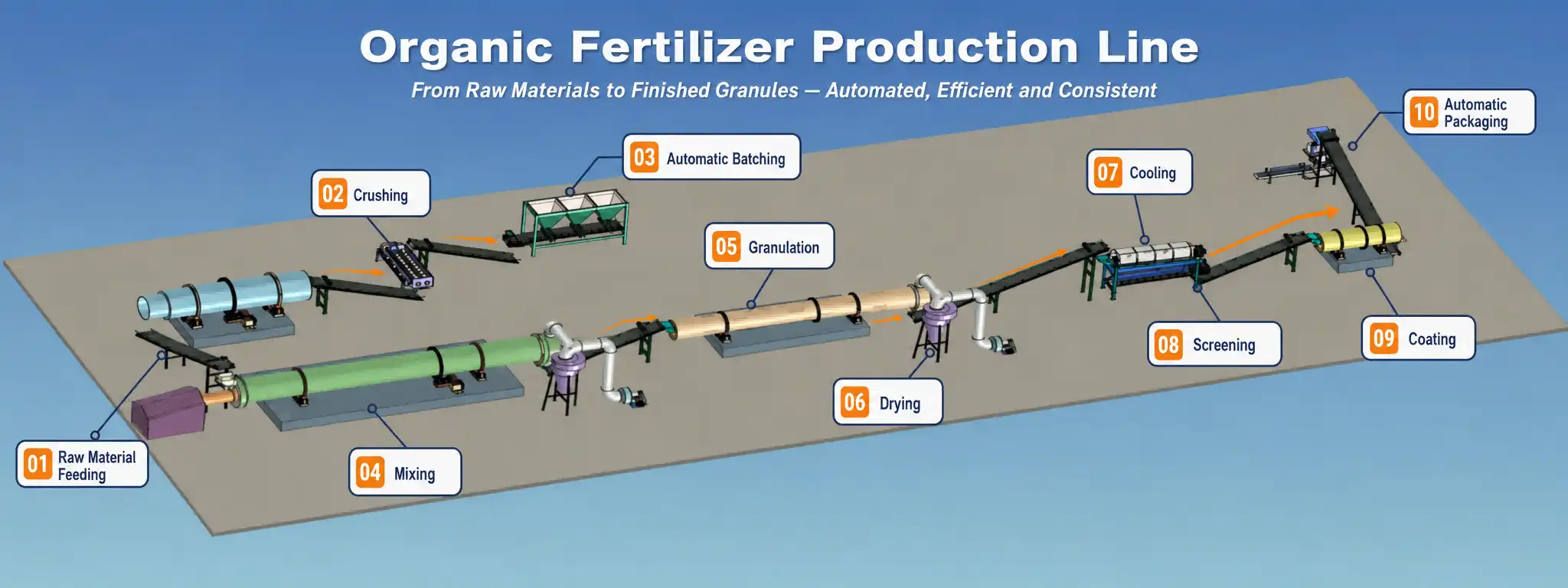
The raw material goes into the granulating room, where particles are pressed together by mechanical pressure or bonding caused by moisture. The product goes through a sieving device that separates fines from on-spec granules. The fines are then recycled back into the feed. Dryers and coolers further downstream remove water from the grain shell and make it harder. Modern extrusion granulators can achieve grinding rates of more than 95%, according to data on how well the equipment works. This keeps material waste low and production efficiency high.
Key Machine Components
The feeding screw, granulating chamber, forming die, cutting assembly, and discharge outlet are the main parts that make it work. Because organic acids and chemical salts in fertilizer materials are very rough, the die and roller surfaces are usually made of alloy steel that doesn't wear down easily. High-molecular-weight polyethylene liners on the inside walls keep materials from sticking and make repair times longer.
Why Granulation Improves Your Product
In every business category, granular fertilizer does better than powdered fertilizer. It doesn't separate nutrients during long-distance shipping, spreads evenly with mechanical spreaders, and looks good in store packages. Granular products meet the business standards that buyers and distributors in Africa, Southeast Asia, and South America need from producers who want to sell their goods abroad.
Types of Fertilizer Granulating Machines
Not all granulators can handle all types of materials or output goals. Wet granulation and dry granulation are the two main types, and each has its own specific machine designs. To make things easier, here is a list of the main types of fertilizer granulating machines.
Disc (Pan) Granulator
Through centrifugal force, a spinning slanted pan rolls wet powder into round pellets. It works well with organic materials and some chemical fertilizers, makes balls that look regular, and costs less up front. The output capacity is usually smaller, and it's important to keep the moisture level steady so that the pellets don't have different sizes.
Rotary Drum Granulator
While a liquid binder is shot in, the material is tumbling inside a big spinning drum with lifting plates inside. It works well for making a lot of NPK and for industrial lines that run all the time. Because they can handle output amounts of more than 10 t/h, rotary drum units are better for big chemical fertilizer plants than for medium-sized organic farms.
Extrusion (Double Roller) Granulator
Without adding water, this dry-process machine presses material between two rollers that spin counterclockwise, stamping it into uniform round or oval pellets. Materials that are sensitive to water or that are already close to the goal density work well with this method. The YUXING YXJY-75 Extrusion Granulator works by taking materials that are 15% to 30% water and turning them into granules that are 2 to 10 mm wide and have a forming density of 0.8 to 1.2 g/cm³. It can do this best at a rate of 4 to 7 t/h with a 75 kW motor. The length of the input material must be at least 20 mm. It is CE and ISO certified, and the company promises to help with installation, operation, and replacement parts for life, 7 days a week.
Applications and Uses of Fertilizer Granulating Machines
Fertilizer pellet machines can be found in a lot of different types of production settings, from commercial organic fertilizer plants to compound fertilizer plants and recycling centers for agricultural waste.
These are the main situations where granulators add real value to production:
- Organic fertilizer pellet production: Fermented animal manure, crop residue, and municipal sludge are processed into odorless, market-ready granules for organic farming and landscaping. Granulation eliminates dust hazards and extends shelf life significantly.
- NPK compound fertilizer manufacturing: Balanced nutrient pellets produced by granulation maintain consistent N-P-K ratios per granule, which prevents nutrient segregation that commonly occurs when powder blends are bagged and shipped over long distances.
- Agricultural waste recycling: Producers in markets like Nigeria, Vietnam, and Brazil convert crop by-products into sellable granular fertilizer, generating additional revenue while reducing on-farm waste disposal costs.
Granulated output meets the needs of commercial distributors, agricultural cooperatives, and retail packagers, which is a benefit that all of these uses share. Once they reach a uniform granule form, powder goods that used to sell for commodity prices move up the value chain.
To get the best results, the feed material should be crushed to a size of about 20 mm beforehand, and the moisture level should stay within the range allowed by the machine. Most of the time, irregular granule output or chamber blockage is caused by feed size changes that aren't consistent and moisture levels rising above the rated limit.
How to Choose the Right Fertilizer Granulating Machine
Being honest about your output goals and the properties of your raw materials is the first step in choosing the right tools. When making a B2B purchasing choice, these are the main things that matter: the capacity and performance of the fertilizer pellet machine, your raw material properties, and your budget.
- Output capacity: Match the granulator's rated throughput to your upstream crushing and mixing line. For a 4–7 t/h operation, a machine like the YXJY-75 aligns directly without creating bottlenecks upstream or underutilizing downstream drying capacity.
- Granule size and density: Confirm that the machine's die configuration produces granules in the diameter range your buyers specify. Commercial fertilizer markets often require 3–5 mm, while bulk agricultural buyers may accept up to 8–10 mm.
- Moisture tolerance: Wet granulation machines handle 20%–30% moisture naturally; dry extrusion machines perform best below 30% but require consistent feed moisture to maintain pellet integrity.
- Wear part replacement cost: Roller skins and forming dies wear over time. Ask the supplier for replacement part pricing and availability before committing to a purchase. YUXING maintains a stable long-term spare parts supply for all equipment it ships globally.
- Certifications and after-sales coverage: CE and ISO certifications confirm that the equipment meets international safety and quality standards. Lifetime technical support reduces the risk of extended downtime, especially for buyers operating in markets where local service technicians may be scarce.
Roller skins and making dies wear out over time, so you have to pay to replace them. Before you decide to buy, ask the supplier how much replacement parts cost and how many are available. YUXING keeps a steady supply of spare parts for all the equipment it ships around the world.
Certifications and service after the sale: CE and ISO certifications show that the equipment meets quality and safety standards around the world. Lifetime technical support lowers the chance of long periods of downtime, which is especially helpful for buyers who do business in areas where there may not be many local service experts.
Maintenance and Troubleshooting of Fertilizer Granulating Machines
There is a big difference between a machine that lasts ten years and one that needs to be completely rebuilt every eighteen months.
Scheduled Inspection Routine
Every 500 hours of use, check the cutting blades, die holes, and roller surfaces. During each shift, check the temperature and greasing points of the bearings. Every 3,000 hours, the internal liner should be checked for wear, and it should be replaced every 6,000 to 8,000 hours, depending on how rough the material is.
Common Issues and Fixes
Uneven granule size is usually caused by feed particles that aren't the same size or by changes in the speed of rotation. Most problems can be fixed by changing the feed rate and making sure the scraper angle is right. Mechanical jams usually happen when the feed material is too big or the moisture level is too high. Both of these problems can be avoided with controls upstream.
When to Call for Support
If the noise level goes over 85 dB or the bearing temperature rises in a strange way during an 8-hour run, stop the machine and call technical support before continuing. For all fitted equipment, YUXING offers remote technical support 24 hours a day, seven days a week, video help, and quick responses to any requests made after the sale.

Conclusion
A fertilizer granulating machine is one of the easiest ways for a medium-sized company to improve the quality and market value of its goods. It depends on your budget, the size of the granules you want to make, the raw materials you have on hand, and how much you can produce. We designed the YUXING YXJY-75 Extrusion Granulator to work in this range: 4–7 t/h, ¥2–10 mm granules, 75 kW, CE and ISO certification, and lifetime customer service. YUXING has been making fertilizer equipment for more than 20 years and has customers in more than 50 countries. They don't just sell equipment; they also help with the whole production line, from getting the raw materials to making the finished product.
FAQ
1. How does a granulator improve fertilizer product quality?
Granulation makes pellets of the same size and the same amount of nutrients in each granule. This keeps the nutrients from getting mixed up while they're being moved and makes sure that mechanical spreaders cover the whole field evenly. When the crushing strength of pellets is above 15N, they don't break when they're being moved or shipped, so they keep their shape from the factory to the field.
2. What is the difference between organic and compound fertilizer granulators?
Granulators for organic fertilizer are made to work with woody, high-moisture biological materials like compost and dung. Compound fertilizer granulators work with NPK materials and blends of inorganic salts that can react at high temperatures. These two types of tools have different internal liners, amounts of moisture tolerance, and ways of granulating.
3. Can I get a machine customized for my specific raw materials?
Yes. YUXING can customize voltage standards, electrical component names, PLC control systems, die configurations, and changes that are made to fit particular materials for both OEM and ODM customers. Customization choices also include meeting CE certification requirements, choosing the language of the working interface, and setting up the dust control.
4. How often do roller skins and dies need replacement?
Internal fillers and making dies should be inspected every 3,000 hours and replaced every 6,000–8,000 hours, depending on how rough the materials are. YUXING keeps a steady stock of spare parts on hand so that there is little downtime between repairs.
Request a Quote from YUXING — Fertilizer Granulating Machine Manufacturer
It's been more than 20 years since YUXING sent fertilizer granulating machines to more than 50 countries in Africa, Southeast Asia, Central Asia, South America, and Eastern Europe. The YXJY-75 Extrusion Granulator comes with CE and ISO certification and can be shipped right away. Standard units are also available, and special versions can be made in 15–20 days. You can email our team at yuxing@hnyxmachinery.com to get a quote, talk about your production needs, or get a full configuration of your production line.
References
1. Food and Agriculture Organization of the United Nations. Fertilizer Use by Crop. FAO, 2006.
2. Nyle C. Brady & Ray R. Weil. The Nature and Properties of Soils. Pearson Education, 2016.
3. International Fertilizer Association. Fertilizer Outlook 2023–2027. IFA, 2023.
4. Mortvedt, J.J., et al. Fertilizer Technology and Use. Soil Science Society of America, 1999.
5. United Nations Industrial Development Organization. Fertilizer Manual. UNIDO & IFDC, 1998.
6. European Fertilizer Manufacturers Association. Production of NPK Fertilizers by the Mixed Acid Route. EFMA, 2000.

USER EVALUATE
Get your tailored fertilizer plant solution — contact us today.