



_1782098484336.webp)
What Are the Key Benefits of a Compost Fermenter?
If you manage a livestock farm, run an organic fertilizer plant, or process municipal solid waste, you already know how costly and unpredictable open-air composting can be. A compost fermentation machine changes that equation entirely. By enclosing the biological decomposition process inside a controlled environment, these systems accelerate organic waste conversion, eliminate odor, destroy pathogens, and produce consistent fertilizer-grade output—regardless of season or weather. This guide walks through the core benefits, how these systems compare to traditional methods, and what to look for when selecting the right unit for your operation.
Understanding Compost Fermentation Machines: Process and Technology How Controlled Aerobic Fermentation Works?
Thermophilic conditions are usually kept between 55°C and 75°C in a vertical aerobic fermentation tank by using forced ventilation, thermal insulation, and mechanical stirring. High-pressure fans move air through the organic matter, which keeps microbes working and speeds up the decomposition process. Temperature, moisture, and oxygen levels are tracked in real time by automated monitors. This lets the system self-regulate during each fermentation cycle. This closed-loop method gets rid of the problems that come up with open windrow composting, where changes in temperature and weather affect the quality of the output.
Equipment Types and Operational Scale
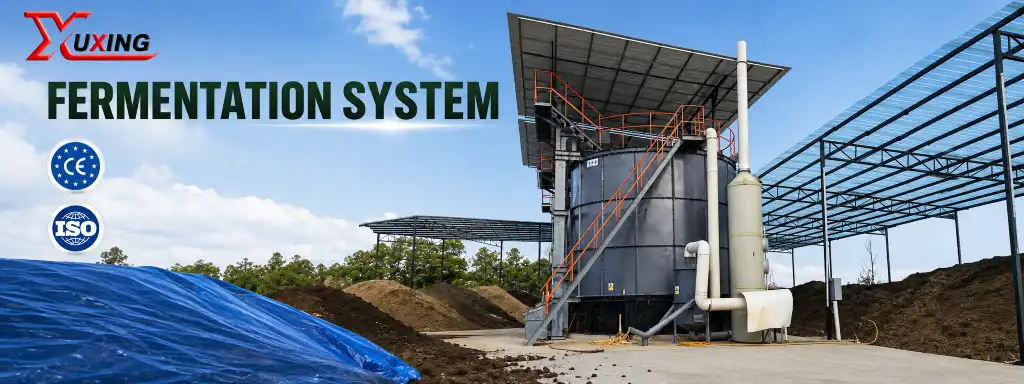
There are different sizes of fermentation systems, from small 5 m³ pilot units to tanks that are over 200 m³ and used in factories. The YUXING YXFJG-120 is a vertical aerobic fermentation tank with a volume of 120m³. It is designed to work well for medium-sized businesses. With a daily feeding capacity of 8–12 m³ and a final output of 3–4 m³ per cycle, it's perfect for farms that raise animals, make organic fertilizer, or process solid waste and need a steady throughput without needing a lot of land or labor. It can be built even on small sites thanks to its 65 m² floor area.
Key Benefits of Using a Compost Fermentation Machine
Closed-system fermentation has many benefits besides just being faster. Here are the main benefits that industry workers get from this technology:
- Accelerated processing cycles: YXFJG-120 speeds up the processing cycles, cutting the time it takes to open compost from 60 to 90 days to just 7 to 15 days. It does this by keeping the thermophilic temperatures stable with 52 mm polyurethane insulation and two 12.5 kW blowers that keep aerobic activity going inside the sealed tank.
- Pathogen and weed seed elimination: Keeping the temperature above 55°C for several days in a row has been shown to kill dangerous organisms like E. coli and Ascaris eggs, meeting the biosafety standards needed for organic fertilizer certification and land application approval.
- Integrated odor control: The YXFJG-120 has a 5.5kW deodorization fan, a 1.5m deodorization tower, a 15m chimney, and a spray tower pump. Together, they make up a multi-stage exhaust treatment system that keeps volatile ammonia and hydrogen sulfide from escaping into nearby neighborhoods.
- Compact footprint: The fermentation compost machine only needs 65 m², which is a small amount of land compared to windrow composting. This frees up space that can be used to process fertilizer, store it, or increase production.
- Automation and reduced labor: The Siemens PLC control system, 10-inch HMI tablet, and remote APP control make it possible for one person to keep an eye on and change the fermentation process without having to keep doing it by hand all the time.
All of these benefits help organic waste producers with their biggest operating problems: being dependent on the weather, getting complaints from neighbors about smells, not being able to be sure how many pathogens are killed, and using up too much land. Together, they turn garbage streams that are hard to predict into a solid source of raw materials for making fertilizer.
Comparing Compost Fermentation Machines to Traditional Composting Methods
Processing Speed and Output Consistency
Most of the time, open windrow composting takes 60 to 90 days to make stable compost. In cold or wet climates, this time frame can be longer. That cycle is sped up a lot in a tight fermentation tank. In addition to speed, the contained environment ensures that each batch of compost has the same amount of water and nutrients, which is not possible with hand turning or exposure to the air.
Environmental Compliance and Regulatory Alignment
Increasingly, regulations in places like the European Union, Southeast Asia, and some parts of Africa call for protected garbage treatment for organic waste from farms and factories. A closed aerobic system doesn't let waste run off into the ground without being managed, and it actively handles exhaust gases. The YXFJG-120 has CE and ISO certifications, which means that operators can meet the requirements for an environmental permit without having to make any changes.
Labor Demand and Long-Term ROI
It takes a lot of work to do things like moving the compost pile over and over, managing the wetness, and keeping an eye on it visually with traditional composting. These tasks are combined into automated routines by mechanized systems. The initial cost of a 120 m³ fermentation tank is higher, but for medium-sized facilities, the savings in work hours, trash handling costs, and product rejection rates usually cover the cost within two to three years of operation.
How to Choose the Right Compost Fermentation Machine for Your Business?
Matching Capacity to Waste Generation
The daily input volume is the most important selection factor. A fermentation compost machine that processes 8–12 m³ per day is good for farms that produce 10–15 tons of manure per day from cattle or chickens, or for companies that process city solid garbage and deal with similar organic fractions. Undersizing a tank makes it hard to move, and oversizing it makes it more expensive to run without making it more productive.
Evaluating Automation and Construction Quality
Buyers should look closely at the complexity of the control system, the quality of the insulation, and the building materials. The YXFJG-120 has a Siemens PLC platform, which is a well-known standard in industrial automation, and it also has remote APP access for monitoring processes from afar. Even when the temperature outside drops below 0°C, the 52mm polyurethane padding inside keeps the fermentation temperature stable. For corrosion resistance, check to see if the material of the tank can handle the amount of acidity and moisture in the waste you'll be putting in.
Supplier Credibility and After-Sales Infrastructure
The service network of the provider has a lot to do with how reliable the equipment is over a 10–15 year operating lifespan. Give more weight to makers that offer on-site fitting help, online commissioning support, and a clear supply chain for spare parts. YUXING offers lifetime 24/7 after-sales service for the YXFJG-120, which includes help with installation, teaching on how to use it, and advice on extra parts.
Maintenance and Troubleshooting Best Practices
Routine Inspection Protocols
A fermentation tank works at its full capacity as long as it gets regular repairs. Every week, operators should check the blower filters, hydraulic oil levels, state of the wire rope, and spray nozzles on the deodorization tower. As part of the monthly checks, the PLC diagnostic log and thermal sensors should be calibrated.
Uneven temperature distribution or stopped decomposition during fermentation is often caused by clogged aeration channels or uneven carbon-to-nitrogen ratios in the feed material. Taking care of these upstream input variables before they add up to mechanical strain saves both the quality of the output and the life of the equipment.
Conclusion
Closed aerobic fermentation technology is better than regular composting in every way that matters to a serious fertilizer maker or waste processor: speed of processing, control of pathogens, management of smells, use of land efficiently, and compliance with regulations. A modern compost fermentation machine can support this controlled process by providing efficient aeration, temperature management, and automated operation. The YUXING YXFJG-120 Vertical Aerobic Fermentation Tank can do all of these things in a small, automatic, CE-certified package made for medium-scale commercial use. YUXING has been making equipment for more than 20 years and has customers in more than 50 countries. They bring both deep technical knowledge and a global service reach to every installation.
FAQ
1. How long does one fermentation cycle take?
Depending on the type of material fed into it, its wetness level, and the temperature outside, the YXFJG-120 can usually finish a main fermentation cycle in 7–15 days. This is a lot faster than open windrow composting, which usually takes between 60 and 90 days.
2. Can this tank process different types of organic waste?
The system takes care of manure from animals like cattle, chickens, and pigs, as well as municipal organic waste, food processing waste, and sludge that has been dried out. To keep aerobic conditions, high-oil sources need to be balanced by adding binding agents like straw or sawdust to change the carbon-to-nitrogen ratio.
3. What power supply is required?
The YXFJG-120 runs on AC380V 50Hz and has 50.37 kW + 3 kW of fixed power. Under normal circumstances, the operating power is about 25 kW, which allows for cost-effective continuous operation.
4. What certifications does this equipment carry?
As a result of being CE- and ISO approved, the YXFJG-120 meets foreign safety and quality standards that are used in most export markets, such as Southeast Asia, Africa, and Europe.
Partner with YUXING for Your Organic Waste Processing Needs
Yuxing has been making compost fermentation machines for more than 20 years and has customers in more than 50 countries. The YXFJG-120 Vertical Aerobic Fermentation Tank is CE and ISO approved and comes with free expert help for life and fast delivery of spare parts. Reach our engineering team directly at yuxing@hnyxmachinery.com to request a technical consultation, capacity assessment, or project quote tailored to your waste volume and site conditions.
References
1. Haug, R. T. The Practical Handbook of Compost Engineering. CRC Press, 1993.
2. Körner, I., Braukmeier, J., Herrenklage, J., & Steinberg, I. "Investigation and optimization of composting processes — test systems and practical examples. "Waste Management," 2003.
3. Rynk, R. (Ed.). On-Farm Composting Handbook. Natural Resource, Agriculture, and Engineering Service (NRAES), 1992.
4. Tiquia, S. M., & Tam, N. F. Y. "Fate of nitrogen during composting of chicken litter. "Environmental Pollution," 2000.
5. Bernal, M. P., Alburquerque, J. A., & Moral, R. "Composting of animal manures and chemical criteria for compost maturity assessment." Bioresource Technology, 2009.
6. European Commission. Regulation (EU) 2019/1009 on EU Fertilizing Products. Official Journal of the European Union, 2019.

USER EVALUATE
Get your tailored fertilizer plant solution — contact us today.