




Small organic fertilizer production line: Production Process & Technology
A small organic fertilizer production line is an integrated system that converts raw organic waste—livestock manure, crop residues, and food byproducts—into market-ready fertilizer through a structured sequence of mechanical and biological processes. Designed for operations processing 4–6 tons per hour, these lines bring affordable, scalable production to small farms and agricultural cooperatives. With global organic fertilizer demand projected to exceed $16 billion by 2030 (Allied Market Research, 2022), getting your production process right from day one is not just smart—it's necessary.
Understanding the Small Organic Fertilizer Production LineWhat It Is and Why It Matters
Three real problems are solved by a small organic fertilizer production line: the high cost of starting an industrial-grade facility, the pressure to follow environmental rules, and the high cost of getting rid of trash. By processing biowaste, animal manure, and straw on-site, farmers turn waste that could hurt the environment into soil amendments that can be sold. This rotating method cuts down on the need for chemical fertilizers while also making farms more money.
Key Raw Materials and Input Standards
Animal dung, crop straw, chicken manure, and municipal organic waste are all common feedstocks. Before preparation starts, the moisture content of the raw materials should fall to a level between 30 and 40% for uniform quality. For materials with more than 50% water, dewatering equipment like a screw press is needed upstream to bring the levels down to a usable level.
Environmental and Agronomic Benefits
The FAO says that using organic fertilizer can increase the amount of organic matter in the soil by 15–20% over three growing seasons. When compared to synthetic fertilizers, powdered organic fertilizer releases nutrients more slowly, which lowers nitrogen runoff by up to 30%. These proven benefits are becoming more important to buyers in Nigeria, Vietnam, and Brazil, where rising prices and land degradation are big problems.
Production Process & Technology Explained
Step-by-Step Workflow of a Powder Line
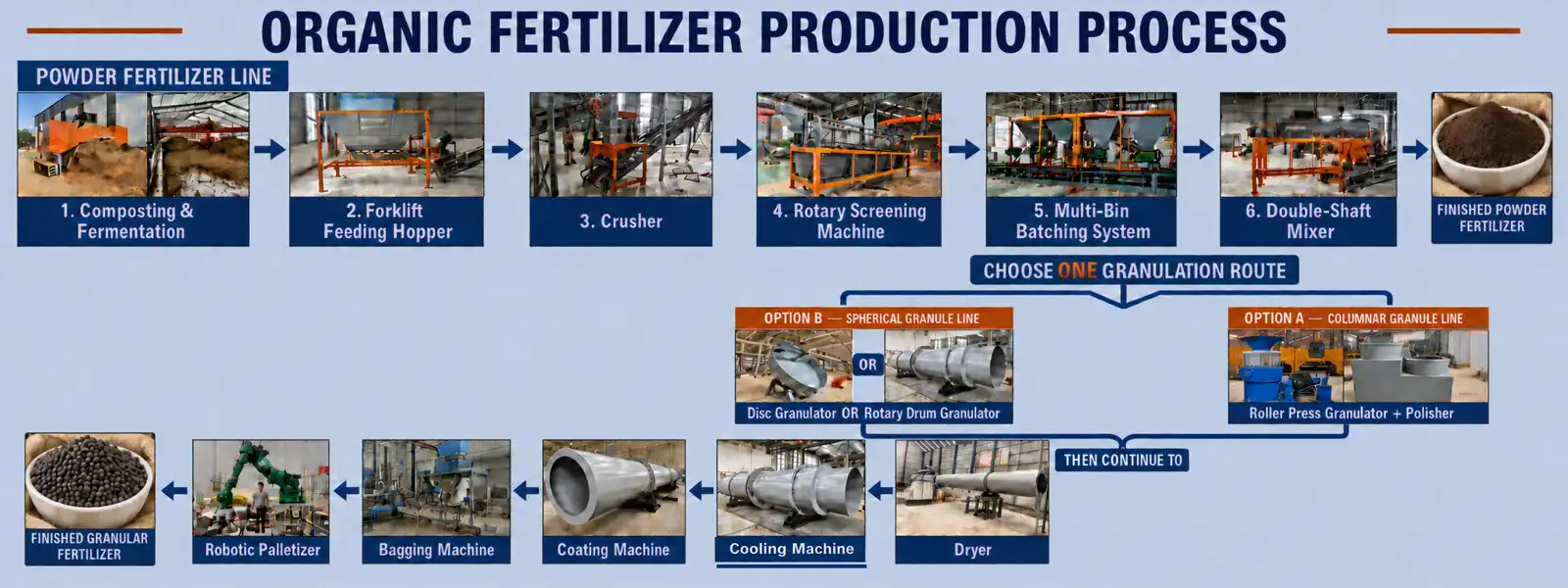
The simple six-step process used by YUXING's 4–6T/H small organic fertilizer production line goes like this: Feeding → Conveying → Crushing → Screening → Conveying → Packing. The loader feeder takes in raw materials that have already been mixed and puts them onto a 600mm-wide belt conveyor that moves at 1.3–1.6 m/s. This keeps the flow steady without any help from a person.
Crushing and Screening Technology
The YXFS-600-LS Vertical Crusher can handle 4 to 6 tons per hour and turns clumped garbage into small, even pieces. Compared to horizontal crushers, its vertical form produces less dust and prevents clogging. Once the material has been crushed, the YXSF-3012 Drum Screening Machine sorts the powder into the right size, and the bigger pieces are then automatically sent back into the machine. With this closed-loop screening method, waste is kept very low, and output quality stays the same.
Control, Packing, and Total Power
The YXDK-50 Control System connects the whole line and lets workers check the packing weight, conveyor speeds, and crusher loads from a single screen. With the powder packing scale, bags are filled correctly, so there is less product loss. This line works well on a standard 380V/440V/480V three-phase supply and has a total installed power of only 49.15 kW. It is compatible with industrial grids in Africa, Southeast Asia, and South America.
Comparative Insights: Small vs. Large Scale Production Lines
Investment Cost and ROI Comparison
A small powder line with a capacity of 4–6T/H usually costs between $20,000 and $80,000 to build, including the cost of the tools, installation, and operation. Large-scale lines that can handle 10+ T/H can cost more than $300,000. If a farm or group doesn't have a lot of money, it's safer to start small and grow later. Many of YUXING's clients in Kenya and Indonesia get their money back within 18 to 24 months of starting to use the tools.
Manual vs. Automated Operation
Manual lines need 4–6 workers per shift and give mixed results. YUXING's powder setup is an example of an automatic line that only needs two or three trained workers. The YXDK-50 control system keeps an eye on the process. This directly lowers the cost of labor, which is important in markets where skilled agricultural labor is hard to find or costs a lot compared to the amount of work that is done.
Organic vs. Chemical Fertilizer Market Position
The market for organic food around the world grew at a rate of 12.5% per year from 2018 to 2023 (Statista, 2023). More and more buyers in the Philippines, Uzbekistan, and Peru want approved organic inputs. A small organic fertilizer production line costs allow its operator to serve this market segment locally, making more money than distributors of chemical fertilizer that comes from other countries.
How to Start a Small Organic Fertilizer Production Line
Site Selection and Regulatory Compliance
To save money on transportation, pick a spot that is less than 5 km from your main source of fuel. Most places that have organic fertilizer plants have to keep buffer zones around residential areas, which are usually 300 to 500 meters wide, and pass local environmental impact studies. The engineering team at YUXING helps clients plan the layout of their plants and prepare the paperwork needed for governmental clearance.
Cost Estimation and Budget Planning
Here is a practical breakdown of typical startup costs for a powder line:
- Equipment package (4–6T/H): $20,000 to $60,000, depending on configuration
- Civil works and utilities: $3,000 to $10,000
- Installation and commissioning: Included in YUXING's turnkey service
- First three months of operations (labor, power, inputs): $5,000 to $15,000
These figures give procurement teams a realistic baseline for budget planning, though actual costs vary by region and site conditions.
Installation, Commissioning, and Staff Training
For every turnkey job, YUXING sends qualified engineers to install and operate the equipment in other countries. After the machines are up and running, on-site training includes how to use them, perform daily care, and fix simple problems. Video call remote support is available 24 hours a day, seven days a week for ongoing operational questions. When standard equipment is in stock, it ships within days. For custom setups, the wait time is 15–20 days.
Choosing the Right Supplier and Brand
Certifications and Customization Capability
CE and ISO licenses are important to look for in a small organic fertilizer production line provider because they show that the equipment meets international safety and manufacturing standards. YUXING has both, and all of its equipment is load-tested for 72 hours before it is sent out. In addition to certifications, you should also ask providers if they can change the voltage standards, electrical component names (Siemens, Schneider), and language of the control interface to meet your needs.
YUXING's Track Record and Service Network
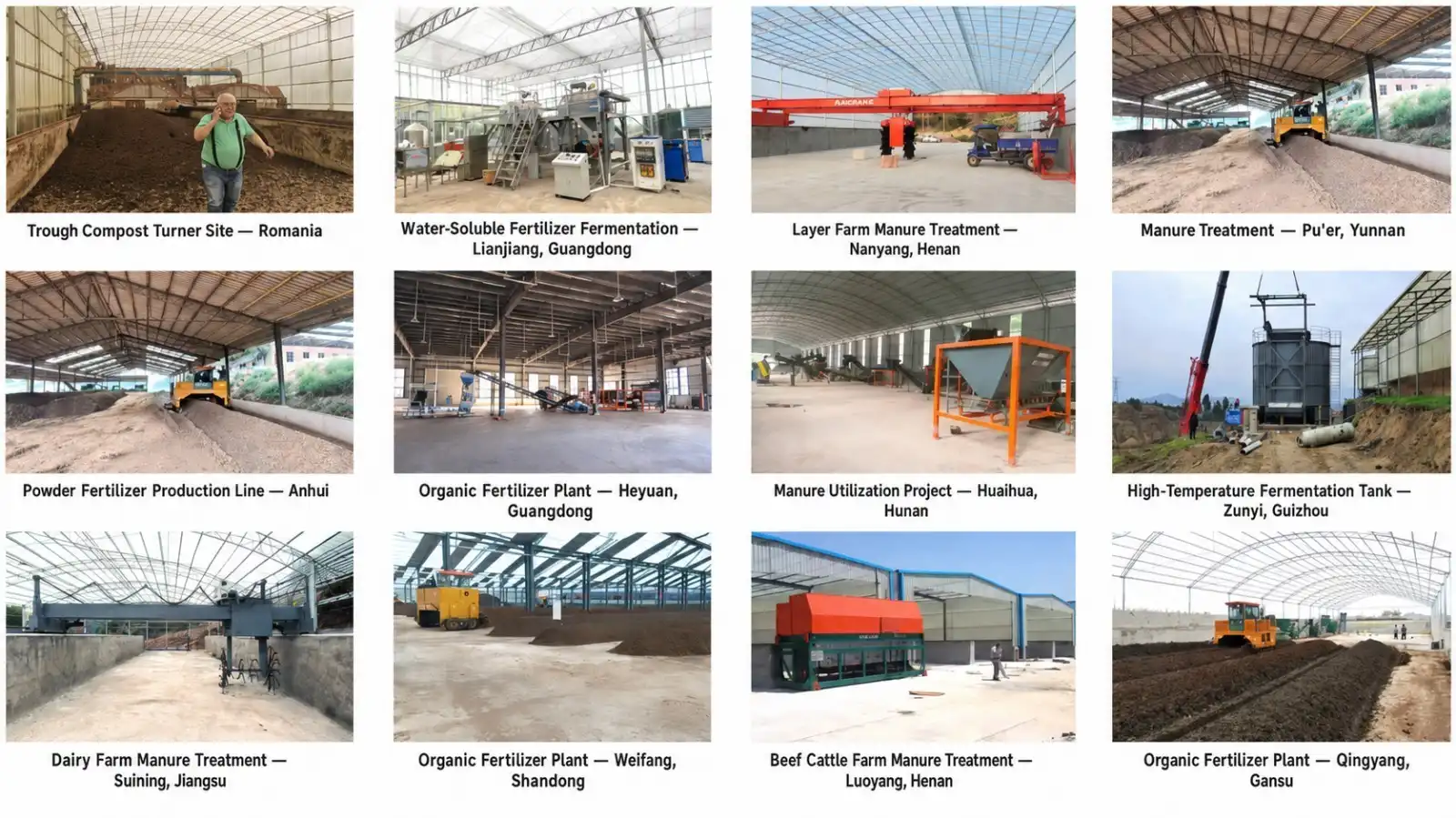
YUXING has built a project history that can be checked, including work in Africa, Southeast Asia, Central Asia, and South America. They have been making fertilizer equipment for over 20 years and have clients in more than 50 countries. The company was the first in the domestic market to sell trough-type and mechanical crawler-type composting turners, and it keeps improving its products based on feedback from customers. Customized shipping plans for 40GP and Open Top containers help buyers from other countries plan their handling costs.
What a Reliable After-Sales Commitment Looks Like
Many suppliers don't do a good job with customer service after the sale. YUXING offers lifetime technical support 24 hours a day, seven days a week. This includes help with installation, finding spare parts, and suggestions for improving the process. From day one, clients are assigned a care person who will help them. This continuity is more important than price cuts up front for long-term businesses in remote farming areas.
Conclusion
Starting a powder organic fertilizer business at 4–6 T/H is a good size for small farms and groups that want to make money off of trash while still following environmental rules. When it comes to farming equipment, the right production line that is the right size, professionally installed, and backed by reliable after-sales support pays for itself faster than most other investments. This can be done with YUXING's 4–6T/H small organic fertilizer production line, which is CE/ISO-certified, low-power, and fully automated. Whether you are new to making fertilizer or just want to improve your old, broken-down equipment, a purpose-built integrated line will give you the stability and control that you can't get with hand methods.
FAQ
1. What raw materials work best in a powder organic fertilizer line?
It works best with dung from chickens, horses, or pigs that has already broken down. When the wetness level is kept below 40%, crop straw and biosolids can also be used. Don't use raw, uncomposted material because it gets stuck in crushers and makes output that isn't up to par.
2. How long does setup and commissioning typically take?
When YUXING has standard equipment in stock, they ship it within days of receiving the order. Installing and starting up a 4–6T/H powder line on-site usually takes 7–14 days, but this depends on how ready the client's site's civil infrastructure is.
3. Can this line handle both dry and moist feedstocks?
The YXFS-600-LS Vertical Crusher works best when the material it's crushing is 30–40% wet. For sources that are more than 50% wet, there needs to be a drying step upstream. YUXING can add this to the overall layout of the line.
4. What maintenance does the equipment require?
Checking the belt tension, crusher blade wear, and drum screen cleanliness every day is part of the routine. Wear parts made of alloy steel usually last between 12 and 18 months when used normally. YUXING ships spare parts all over the world and provides maintenance schedules during the commissioning process.
Get Your Custom Quote from YUXING Today
YUXING specializes in small organic fertilizer production line solutions that are made to work in real farms. As a reliable small organic fertilizer production line maker with customers in more than 50 countries, we offer CE/ISO-certified equipment, installation by an engineer in another country, and expert support 24 hours a day, 7 days a week, for life. Contact our team to get a unique setup and an idea of how much the job will cost. Get in touch with us at yuxing@hnyxmachinery.com to begin your project right away.
References
1. Allied Market Research. Organic Fertilizer Market – Global Opportunity Analysis and Industry Forecast, 2021–2030. 2022.
2. Food and Agriculture Organization of the United Nations (FAO). The Role of Organic Matter in Sustainable Soil Management. 2021.
3. Statista Research Department. Global Organic Food and Beverage Market Growth Rate, 2018–2023. 2023.
4. Cooperband, L. The Art and Science of Composting: A Resource for Farmers and Compost Producers. University of Wisconsin–Madison Center for Integrated Agricultural Systems. 2002.
5. Rynk, R. (Ed.). On-Farm Composting Handbook. Northeast Regional Agricultural Engineering Service (NRAES). 1992.
6. Shen, Y., et al. "Effects of Organic Fertilizer Application on Soil Physical and Chemical Properties and Crop Yield." Journal of Soil Science and Plant Nutrition, Vol. 21, No. 3. 2021.

USER EVALUATE
Get your tailored fertilizer plant solution — contact us today.