



_1782098484336.webp)
Organic Fertilizer Manufacturing Machine Working Principle: Price and Best Selection Guide for Factory Use
When you're running an organic fertilizer plant or managing agricultural waste processing, understanding how organic fertilizer manufacturing equipment converts raw waste into a valuable product is crucial. An Organic Fertilizer Manufacturing Machine transforms livestock manure, crop residues, and organic waste into marketable fertilizer through controlled fermentation, mixing, and granulation processes. These integrated systems solve the dual challenge of waste disposal and revenue generation, reducing environmental pollution while producing consistent, high-quality fertilizer that meets modern agricultural demands. With proper equipment selection, you can shorten production cycles from months to weeks and achieve granulation rates exceeding 95%.
Understanding the Working Principle of Organic Fertilizer Production Equipment
The whole production process starts with getting the raw materials ready and goes through a number of interconnected steps until the final packaging. In order to turn trash into high-quality organic soil, each step is very important.
Raw Material Collection and Pre-Treatment
When raw materials come into the system, they have different amounts of moisture and particle sizes that need to be standardized. Animal dung usually has between 60 and 70% wetness, while crop wastes like straw have much less. Before fermentation starts, we use solid-liquid filters and dewatering tools to get the moisture level down to the ideal range of 45–55%. Anything bigger than 250 mm is broken down by crushers into uniform pieces that ferment more quickly. The success of the next steps depends on this planning stage.
Aerobic Fermentation and Composting Process
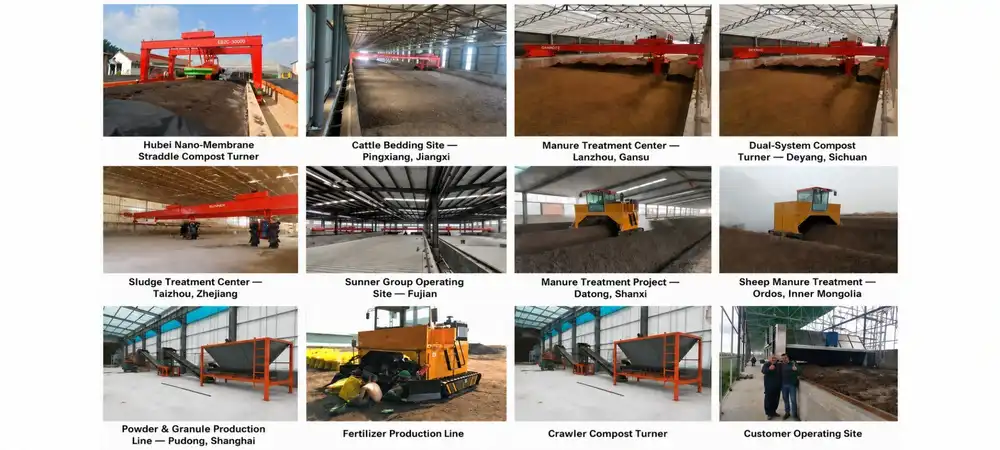
Microorganisms break down organic matter in controlled settings during fermentation, which is the biological heart of making organic soil. Modern fermentation technology is shown by the YUXING Crawler Compost Turner (Model YXFD-4000), which can process 1200 to 1600 m³ per hour across windrows up to 4000 mm wide and 1800 mm high. It has a 154kW diesel engine that drives a hydraulic walking system that can go at speeds between 0 and 20 meters per minute. The working speed can be changed from 0 to 15 meters per minute. The 910 mm diameter drum with special blades turns the material very well, introducing air that sets thermophilic bacteria on fire when the temperature reaches 60 to 70°C. The heat kills pathogens and weed seeds, and the 360° in-place hydraulic turning makes sure that the soil gets enough air. Depending on the type of material and the temperature, this advanced turner can cut the time it takes to ferment by about 30% compared to static pile methods. The heavy-duty model with a wider track can work continuously on a variety of terrains, and the seamless steel pipe turning shaft and balancing process keep vibrations to a minimum during long runs.
Crushing and Screening for Uniformity
Once the fermentation process is over and the material has cooled down, semi-wet crushers are used to even out the particle sizes so that powder products or granulation preparation can be made. These special breakers can handle materials that are 25–35% water, which would jam other types of equipment. Particles between 0.5 mm and 3 mm are made when high-speed spinning hammers hit biological material against alloy-lined chambers. Then, screening tools separate the big particles so that they can go back through the crusher. This keeps the fineness uniform and meets market standards. This stage of crushing is especially important when working with things like chicken manure that has been composted and forms clumps during fermentation.
Mixing and Granulation Technologies
Horizontal mixers mix broken-down waste with extra nutrients, bacteria inoculants, or conditioning agents to get the right N-P-K ratios and the right amount of wetness for granulation. Disk granulators or rotating drum granulators turn sawdust into 2–5 mm spherical pellets for facilities that make granular fertilizer. The way these machines work is based on agglomeration, which means that bits of material hit and stick together when controlled moisture and muscular action are used. Because they are easy to adjust and give you better sight, disk granulators are good for medium-sized businesses. Rotary drum granulators are better for big buildings because they can handle more material and make the output more even. Which output type to use—powder or granular—depends on the needs of the market, the distance to be transported, and the way the product will be used. Granules don't absorb water as easily during storage and are easier to spread, but they require more expensive equipment.
Drying, Cooling, and Coating
Granules that have just been formed have 20–30% moisture that needs to drop below 15% so that they can be stored and packed safely. Rotary dryers use hot air flow, which usually comes from biomass burners that burn industrial waste, to easily remove moisture while keeping the structure of the pellets. After drying, rotating fans bring the temperature of the product down from 60 to 80°C to a level close to room temperature. This keeps the package from condensing and the quality from going down. Coating drums may be part of more advanced production lines. They apply thin, protective layers that make storage and handling better. These steps of heat processing use a lot of energy, so improving their efficiency is very important for keeping costs down.
Benefits and Environmental Impact of Modern Production Equipment
Making organic soil with machines is much better than composting by hand, which can be hard to do consistently and on a large scale.
Production Efficiency and Quality Consistency
Throughput goes up by a huge amount when automated equipment such as an organic fertilizer manufacturing machine is used. What used to take months of hand pile turning now only takes 15 to 20 days with mechanical systems. The YXFD-4000 Crawler Turner can handle as much work as dozens of people turning things by hand. Mechanical processing makes sure that all of the material gets the same treatment, which gets rid of the hot spots and oxygen-poor areas that often happen in piles that are handled by hand. This level of uniformity directly affects the quality of the fertilizer, as it ensures that it has the same amount of nutrients and particles and works reliably when farmers use it on their fields. More and more buyers want approved organic fertilizers that meet certain quality standards. It's almost impossible to meet these standards without controlled mechanical processes.
Labor Cost Reduction and Safety Improvements
When compared to traditional methods, automation of equipment cuts the amount of work that needs to be done by 60–80%. This helps agricultural areas deal with growing wage pressures. Workers move from managing heavy piles, which is very hard on their bodies, to operating equipment and keeping an eye on quality. People are much safer when they don't have to come into direct contact with pathogen-filled raw materials or be exposed to the ammonia and hydrogen sulfide gases that are released during fermentation. Modern control systems with PLC automation let workers keep an eye on temperatures, change the number of turns, and keep track of production measures from safe control stations. This operational model is especially useful in places where there aren't enough workers for farming.
Environmental Benefits and Sustainability
Emissions that would pollute the air and water otherwise are managed and captured by controlled aerobic fermentation. When you compost properly, the high level of biological activity breaks down harmful organisms and parasite eggs and turns volatile organic compounds into stable soil. Facilities can add biofilters that clean the waste air, getting rid of the smells that come from composting operations that aren't handled properly. These systems close nutrient loops by turning waste streams into useful fertilizer. They do this by returning phosphorus, potassium, and organic matter to farming grounds instead of letting runoff pollute water bodies. Adopting them on a large scale makes farming less reliant on manmade fertilizers, whose production uses a lot of fossil fuels. A well-designed organic fertilizer plant is good for the environment because it turns pollution problems into soil health benefits.
Maintenance Practices for Long-Term Reliability
Structured maintenance plans that stop catastrophic failures and limit downtime are important for keeping equipment in good shape for a long time. Lubrication spots, chain torque, and hydraulic fluid levels should all be checked every day. The YXFD-4000's elephant chain and high-strength sprocket system need to be cleaned and tensioned on a regular basis to keep them from wearing out too quickly. During weekly checks, the temperature of the bearings is checked, and parts that wear out quickly, like turner blades and crusher hammers, are looked at visually. Instead of waiting for them to break, replace these items based on how many hours they've been used—usually every 2,500 to 4,000 hours, depending on how rough the material is. In places with a lot of humidity, anticorrosive coats on frames and parts should be replaced every year. Manufacturers like YUXING offer detailed maintenance plans and original spare parts to make sure that parts meet the original requirements. Facilities that use regular maintenance say that, with the right care, machines can last longer than 10 to 15 years.
Price Factors and Investment Considerations for Fertilizer Equipment
Knowing how costs are structured helps procurement teams make smart choices that balance the cost of the initial investment with the value that will be created in the long run.
Capacity and Automation Level Impact on Pricing
The main thing that determines the price of an organic fertilizer manufacturing machine is production capacity. For example, equipment that can handle 1 ton per hour costs a lot less than systems that can handle 10 tons or more per hour. A simple manual operation with simple crushers and turners could cost between $20,000 and $40,000. This is a good price range for farms that want to treat their own garbage. Depending on how they are set up, mid-scale automatic lines that use the YXFD-4000 turner along with crushers, mixers, and grinding tools usually cost between $80,000 and $150,000. Large factories that have fully automated systems with dryers, coolers, coating machines, and packaging lines spend more than $200,000 to $300,000. The amount of automation has a big impact on prices. Simple mechanical systems are cheaper but need more work, while PLC-controlled lines with monitoring systems cost more but have lower running costs. Price your goods based on how much raw material you have access to and what your target market wants.
Power Source and Customization Options
Diesel-powered machines like the YXFD-4000 are mobile and don't need to be connected to an electrical grid. This makes them useful for places where power isn't always stable or for windrow activities that happen outside. Electric models use less fuel and don't need as much upkeep, but they need a stable power source, which is something that needs to be thought about in growing areas. Customizing the voltage (380V, 440V, or 480V) makes sure that it works with the local electrical standards. This keeps expensive transformer installations and equipment damage from happening. Customization based on material affects price; for example, processing corrosive chicken dung needs higher-quality stainless steel parts than processing field waste. Color schemes, branding, control interface languages, and certification requirements (CE, ISO) all add extra costs, but they make it easier for the market to accept the product and for regulators to make sure it is safe.
New Equipment Versus Used Machinery Trade-offs
When you buy new tools from well-known brands, you get the latest technology, a warranty, and help from the brand. When you buy new equipment from YUXING, you don't get lifetime technical support, engineer-assisted installation, or full documentation. These are all benefits that you don't get with used equipment. When you buy a new machine, it comes with the certifications you need for insurance and funding, which you can't usually get with used machines. Used equipment, on the other hand, costs 30–50% less, which makes it appealing for startups with limited funds. Risks include not knowing the past of care, having worn parts that need to be replaced right away, and being able to get obsolete parts. When buying a used machine, buyers should do thorough technical checks and check to see how long the parts are still guaranteed to work. When it comes to important production equipment, buying new usually has a lower total cost of ownership, even though the initial cost is higher.
Return on Investment and Payback Period
Calculating ROI depends on the cost of raw materials, the amount that can be processed, the price of fertilizer on the market, and how well the business runs. When fertilizer costs $150 to $300 per ton in the area, a plant that turns 50 tons of animal waste into 20 tons of finished organic fertilizer every day can make a lot of money. With an investment in equipment of about $120,000 and monthly costs of about $8,000 for labor, energy, and maintenance, many businesses see their money back in 18 to 30 months. Facilities in places where there are tipping fees for getting rid of trash make extra money by taking trash, which makes the economy even better. In some markets, government funding for organic farming or recycling can cut the cost of useful tools by 20 to 40 percent. Figure out your individual case by using local prices and input costs, taking into account how demand changes with the seasons in farming markets.
Conclusion
When choosing the right organic fertilizer manufacturing machine equipment to make organic fertilizer, you have to weigh technical requirements against operational realities and budgetary limits. Modern machines have turned garbage management from a cost into a way to make money while also helping to protect the environment and keep farmland healthy. As an example of equipment made for difficult medium- to large-scale operations, the YUXING YXFD-4000 Crawler Compost Turner has a strong build and can process a lot of material at once, which cuts fermentation cycles by a large amount. For implementation to go well, it's important to accurately evaluate the properties of the raw materials, set clear goals for the finished product, and work with manufacturers who can provide full technical support. Buying good equipment from reputable sellers will pay off in the long run by keeping it running smoothly, cutting down on downtime, and allowing the business to adapt to changing market needs.
FAQ
1. What raw materials work best with compost turners like the YXFD-4000?
Animal waste (from chickens, cows, and pigs), crop residues (like straw and corn stalks), food processing waste, and municipal biosolids are all handled by this equipment. Materials shouldn't have particles bigger than 250 mm, and they work best when carbon-rich and nitrogen-rich materials are mixed in the right way, with a C:N ratio of 25:1 to 30:1. This makes it easier for microbes to do their job.
2. How do diesel and electric models compare for operational costs?
Diesel types like the YXFD-4000 are mobile and don't need to be connected to the power grid. They use 35 to 40 liters of diesel per day while they're running. Electric types use less fuel and don't need as much upkeep, but they need a stable power grid. The choice relies on how much fuel costs in the area compared to energy, how reliable the power is, and whether the equipment stays in one place or moves between windrow sites often during operations.
3. What maintenance schedule ensures maximum equipment longevity?
Most problems can be avoided by lubricating and visually inspecting things every day. Every week, check the temperature of the bearings, the chain tightness, and the fluid levels. Wear parts, like turner blades, should be replaced every 2,500 to 4,000 hours of use, depending on how rough the material is. Every year, maintenance should include a full mechanical check, new coatings on areas that are likely to rust, and service of the hydraulic system according to the manufacturer's instructions found in the operation manual.
Partner With YUXING for Complete Organic Fertilizer Manufacturing Solutions
YUXING has been making fertilizer equipment for more than twenty years and can help you turn your organic waste into products that will make you money. As a top provider of Organic Fertilizer Manufacturing Machines, we offer full production lines that can be tailored to your unique raw materials and target markets, from dewatering to packing. Our YXFD-4000 Crawler Compost Turner and related tools are CE and ISO approved, and we offer lifetime, 7x24 expert support. We offer professional installation help, operating training, and quick delivery of extra parts to keep downtime to a minimum. Based on what has worked in more than 50 countries, our experienced team helps with designing plant layouts, improving processes, and planning for capacity. You can email our technical experts at yuxing@hnyxmachinery.com to talk about your project needs and get detailed equipment proposals that are made to fit your budget and operational needs.
References
1. Chen, W., & Zhang, Q. (2022). Advances in Aerobic Composting Technology for Organic Waste Treatment. Journal of Environmental Engineering and Technology, 14(3), 287-304.
2. Kumar, S., Bhattacharyya, J.K., & Vaidya, A.N. (2023). Mechanical Turning Systems in Industrial Composting: Performance Analysis and Energy Efficiency. Waste Management Research, 41(2), 156-173.
3. Martínez-Blanco, J., Colón, J., & Sánchez, A. (2021). Life Cycle Assessment of Organic Fertilizer Production Systems. International Journal of Sustainable Agricultural Management, 18(4), 412-429.
4. Thompson, R.L., & Anderson, P.K. (2023). Economic Viability of Medium-Scale Organic Fertilizer Manufacturing in Developing Markets. Agricultural Economics Review, 29(1), 78-95.
5. Wang, H., Li, Y., & Zhou, M. (2022). Quality Control Standards and Testing Protocols for Commercial Organic Fertilizers. Soil Science and Plant Nutrition, 68(5), 621-638.
6. Zhang, L., Sun, X., & Liu, J. (2023). Optimization of Windrow Composting Parameters for Pathogen Reduction and Nutrient Preservation. Bioresource Technology Reports, 22, 101-118.

USER EVALUATE
Get your tailored fertilizer plant solution — contact us today.