




How Does Compost Turning Equipment Improve Compost Quality?
If you manage a livestock farm, run an organic fertilizer plant, or operate a commercial composting site, you already know that compost quality is everything. Poor aeration, uneven decomposition, and persistent odors can ruin a batch and damage your reputation. Compost turning equipment directly addresses these problems by mechanically mixing, aerating, and regulating temperature across the entire pile. The result is faster fermentation, more uniform output, and a finished product that meets the standards your buyers expect. Done right, mechanical turning can reduce fermentation cycles from several months down to just 7–15 days.
Understanding Compost Quality Challenges and How Turning Equipment Solves Them
The main problems that every recycling business faces are the same. The first step in solving quality problems is to figure out what goes wrong.
Uneven Decomposition and Anaerobic Zones
If you don't move the organic matter in the middle of the pile, oxygen levels drop. Anaerobic bacteria take over and make hydrogen sulfide and ammonia, which smell bad and break down things slowly. Turning the mass mechanically on a regular basis breaks up these dead zones and brings air back into the mass, which is what aerobic bacteria need to grow.
Temperature Regulation Through Consistent Mixing
According to the U.S. Composting Council, it is important to keep the temperature inside the pile between 55°C and 70°C for a long time in order to kill pathogens. When turning by hand, this is rarely possible. The cooler outer material is cycled into the hot core by mechanical turning equipment. This spreads the heat evenly and makes sure that every part of the windrow meets the required threshold.
Moisture Balance and Contamination Control
It gets clumpy and hard for air to flow when the moisture level is above 70%. When the moisture level drops below 40%, microbes stop working. A well-made trough turner moves the material in a controlled way that lets the moisture naturally move around. Regular turning also stops pests from coming in and lowers the chance that weed seeds will survive, which makes the waste cleaner and safer.
Key Features and Types of Compost Turning Equipment That Enhance Compost Quality
Every machine is different in how it works. Choosing the right type for your operation's size and layout can make a big difference in both the quality of the output and the cost of running it.
Windrow Turners, Static Pile Turners, and In-Vessel Systems
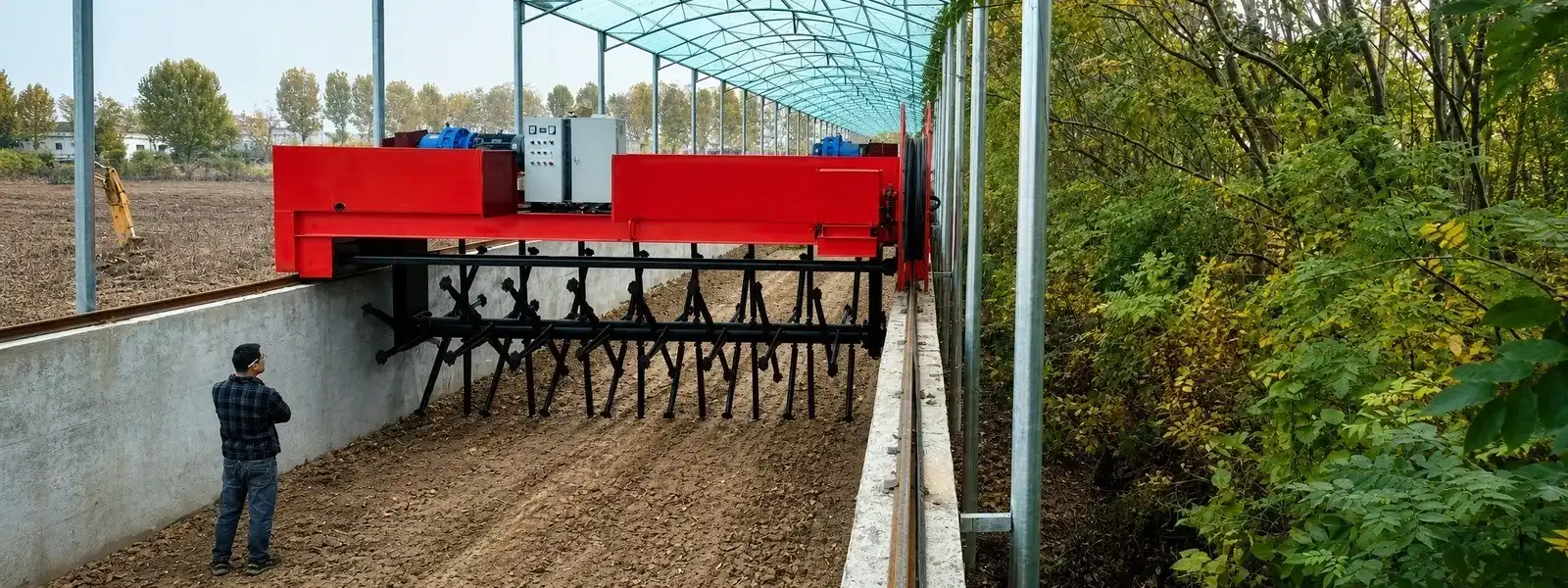
Self-propelled windrow turners can work well in large outdoor areas because they can go across open-air rows. Static aerated pile systems don't have any moving parts; instead, they use networks of blowers. This works well in tight spaces. In-vessel devices have the best control over the process, but they cost more to buy. A groove-type trough turner is the best choice for medium-sized businesses with structured fermentation troughs because it balances cost, throughput, and control the best.
The YUXING YXFP-3000: A Purpose-Built Trough Turner
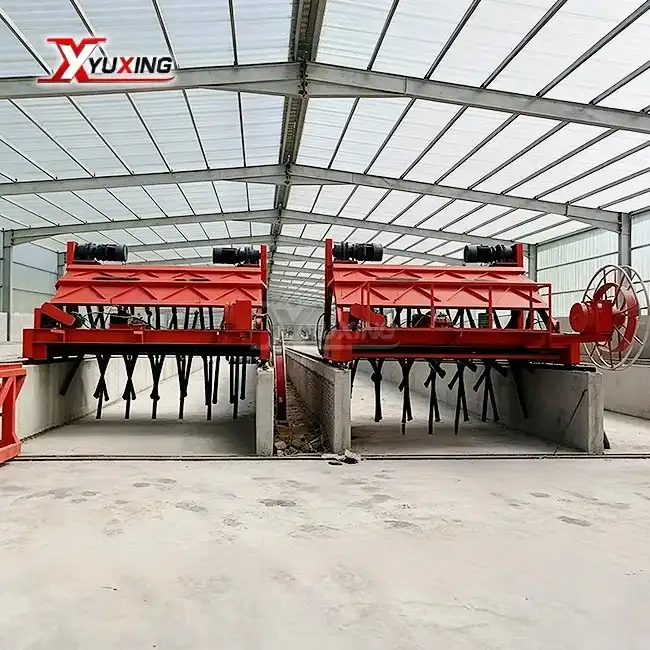
The YXFP-3000 One-machine Whole-trough Compost Turner from YUXING is a great example of windrow turning machine technology that was made just for that reason. Its 3000mm moving width and 0.8–1.2m height range make it ideal for medium-sized businesses that process manure from animals or mixed organic garbage. The machine can make up to 200 m³ per hour. It is powered by two 15kW motors on opposite ends of the turning shaft, which are connected to two cycloidal pinwheel reducers and a double-row 20A chain-and-sprocket transmission system.
Here are the most important basic details to keep in mind:
- Travel speed: 1–10m/min, speed-regulating and adjustable to match material density
- Control method: Both manual and remote control, reducing operator exposure to high-ammonia environments
- Multi-trough transfer function: One machine serves multiple fermentation troughs via an included transfer car, reducing the need for duplicate equipment investment
- Drive system: 8 pieces of 290mm cast steel travel wheels for stable movement in corrosive conditions
- Hydraulic lifting system: Included, allowing the turning drum to adjust height across varying pile depths
These requirements immediately lead to more consistent aeration and lower handling costs per batch. One machine that serves multiple troughs makes better use of your site and lowers your capital costs, which is very helpful for businesses that need to run three to six busy fermentation channels at the same time.
Operational Best Practices to Maximize Compost Quality Using Turning Equipment
Picking the right machine is just one part of the process. How you handle it every day determines how well you make compost every time.
Turning Frequency and Microbial Activity
Cornell University's Composting Extension program found that turning piles every three to five days during the active phase can cut the time it takes to ferment by up to 60% compared to piles that stay still. The YXFP-3000 has an adjustable travel speed that lets operators set the speed to match the density of the material. This way, operators can avoid over-aerating dry batches or under-mixing high-moisture loads.
Monitoring Temperature and Moisture Before Each Turn
Use a compost thermometer to check the core temperature before each turning cycle and change the number of turns based on the reading. When the turn cycle is over, add water if the moisture level falls below 45%. The YXFP-3000 can work with liquid injection add-ons, and its remote control feature lets operators make changes in real time without going into the fermentation area, which is useful in places where animal manure is high in ammonia.
Equipment Maintenance to Prevent Downtime
The parts of a trough turner that wear out the fastest are the turning teeth on the drum shaft. Every 500 hours of use, high-manganese steel teeth should be checked in places with rough manure. Every week, grease the chain and sprocket transmission parts, and every month, check the thickness of the hydraulic fluid. YUXING offers expert help and spare parts consultation for life, so operators can always get real replacement parts without having to wait for long lead times.
Comparative Analysis: Mechanical Turning vs. Manual Methods and Equipment Types
To make a business case for mechanical tools, you need to have accurate numbers.
Labor Cost Reduction With Mechanical Turning
A normal farm with 50 tons of manure per day would need 8–12 workers to handle the piles by hand. With industrial compost turning solutions like the YXFP-3000, that work is done by a single person who controls multiple troughs from a distance. In a year, the money saved on labor alone can often cover the cost of the machine within the $3,000–$35,000 price range that most medium-sized companies can afford.
Electric vs. Diesel Power Sources
Electric trough turners don't make any direct pollution at the work site, which is becoming more and more common in South America, Southeast Asia, and Africa. The YXFP-3000 gets its power from a cable reel system that comes with it. This means that it can be used in composting facilities that are connected to the power grid. Diesel self-propelled turners can work without an electrical connection, but they cost more in fuel and repairs over the course of a year.
Portable vs. Stationary Units for Different Site Layouts
If you manage a livestock farm, run an organic fertilizer plant, or operate a commercial composting site, you already know that compost quality is everything. Poor aeration, uneven decomposition, and persistent odors can ruin a batch and damage your reputation. Compost turning equipment directly addresses these problems by mechanically mixing, aerating, and regulating temperature across the entire pile. The result is faster fermentation, more uniform output, and a finished product that meets the standards your buyers expect. Done right, mechanical turning can reduce fermentation cycles from several months down to just 7–15 days.
Strategic Procurement Insights: How to Choose the Right Compost Turner
Before making an order, make sure that the machine's specs meet the amount of trash you produce each day, the size of your trough, and your power source.
Matching Capacity to Waste Volume
At about 200m³/h, the YXFP-3000 can handle large amounts of material every day across several troughs. Figure out how much manure you produce at its peak each day (in cubic meters), then tell the machine how many trough passes it needs to make each day. This keeps both overcapacity trash and handling bottlenecks from happening during busy times of the year.
Supplier Credibility and Certification Standards
Give sellers with CE and ISO certifications more weight. Both are held by YUXING, and the YXFP-3000 meets CE safety standards for both hardware and electricity. YUXING has been making fertilizer equipment for over 20 years and has clients in more than 50 countries. They have a proven track record and can help with localized projects, such as adjusting voltage, integrating PLC automation, and custom branding for OEM buyers.
Total Cost of Ownership Beyond Purchase Price
Take into account the supply of extra parts, the need for training, and the time it takes for customer service after the sale. YUXING's 7x24 lifetime after-sales service includes help with installation, practical support, and parts advice. This lowers the cost of unplanned downtime, which over a five-year period of use often exceeds the price of the original equipment.
Conclusion
Over time, mechanical compost turning regularly does a better job than manual ways in terms of fermentation speed, product uniformity, and cost of operation. If you run the right compost turning equipment at the right frequency and keep it in good shape, you can cut a breakdown cycle that normally takes months down to 7–15 days while still meeting standards for disease reduction. The YUXING YXFP-3000 has the power, control, and sturdiness for medium-sized businesses with organized fermentation troughs to make compost that is ready for sale at a price that is competitive. Buying tried-and-true equipment for turning is one of the best ways to improve the quality of the compost and make the business more profitable.
Frequently Asked Questions
1. How often should I turn compost for the best results?
During the active fermentation phase, turning every 3–5 days produces the fastest decomposition and most uniform temperature distribution. Once the pile enters the curing phase, weekly turning is sufficient.
2. Can turning equipment handle moisture content above 70%?
Operating above 70% moisture causes clumping and restricts aeration. Add dry bulking agents such as straw or sawdust to bring moisture down to 55–65% before running the turner. This protects both compost quality and the machine's transmission components.
3. How does mechanical turning meet EPA pathogen reduction requirements?
By ensuring every portion of the compost pile reaches at least 55°C (131°F) for a minimum of 3–15 days through consistent turning cycles, mechanical turners satisfy the Process to Further Reduce Pathogens (PFRP) standards set under EPA 503 regulations.
4. What is the typical service life of turning teeth?
In high-abrasion manure environments, high-manganese steel turning teeth generally require inspection every 500 operating hours. Replacement intervals depend on feedstock type and operating frequency.
Get Your Compost Operation Running at Full Capacity With YUXING
YUXING has been making reliable compost turning equipment for more than 20 years and has customers in more than 50 countries. After the sale, the YXFP-3000 comes with lifetime 7x24 technical support and is CE and ISO certified. It was made to work in environments with corrosive manure. You can email our technical team at yuxing@hnyxmachinery.com to get price information, specs, or a site inspection.
References
1. U.S. Composting Council. Compost Facility Operating Guide. 2008.
2. Cornell Waste Management Institute. On-Farm Composting Handbook. 1992.
3. U.S. Environmental Protection Agency. A Plain English Guide to the EPA Part 503 Biosolids Rule. 1994.
4. Haug, R. T. The Practical Handbook of Compost Engineering. Lewis Publishers, 1993.
5. Rynk, R. et al. Compost Production and Use. BioCycle Journal of Composting and Organics Recycling, 2002.
6. Food and Agriculture Organization of the United Nations. Livestock's Long Shadow: Environmental Issues and Options. FAO, 2006.

USER EVALUATE
Get your tailored fertilizer plant solution — contact us today.