




How does a tracked compost turner Work?
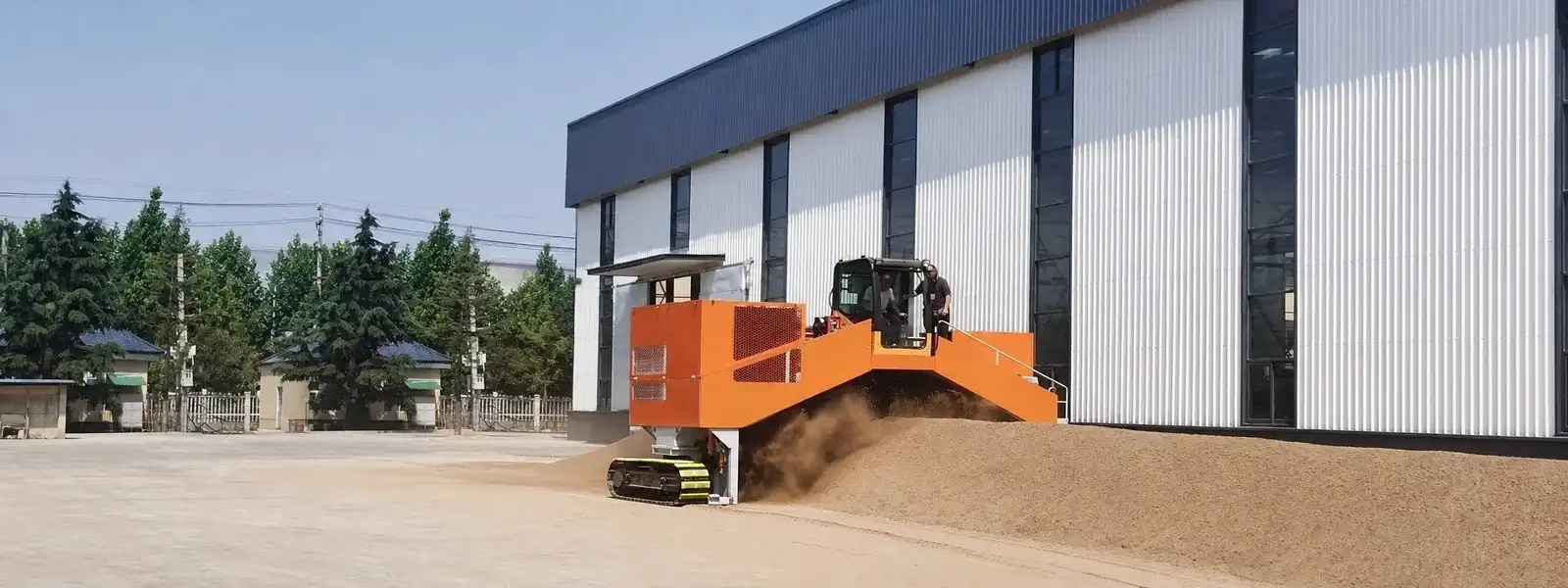
A crawler compost turner is a track-driven aerobic fermentation machine engineered to convert large volumes of organic waste into mature compost efficiently. Unlike wheeled alternatives, it uses a continuous rubber or steel track system to move steadily across soft, uneven, or wet windrow surfaces. As it travels forward, a high-speed rotating drum fitted with hardened alloy teeth penetrates the pile, lifts material upward, breaks up dense clumps, introduces fresh oxygen, and redistributes moisture—all in a single pass. This mechanical action dramatically accelerates microbial activity, shortening the fermentation cycle from months to as few as 7–15 days.
Understanding How a Tracked Compost Turner Works?
A tracked windrow turner works by doing three things at the same time: mechanically aerating the material, mixing the materials, and controlling the temperature. When the rotating drum hits the windrow, it releases the trapped carbon dioxide and replaces it with oxygen from the air. This sets off thermophilic microbial populations that produce heat above 55°C, which is the temperature needed by U.S. EPA 40 CFR Part 503 standards to effectively kill pathogens.
The Crawler Chassis and Its Role
The weight of the machine is spread out over a large contact area, which is recorded in low kilopascals of ground pressure. This keeps the dirt from packing down under the base of the windrow, which would otherwise make anaerobic areas that slow down decomposition and give off smells of hydrogen sulfide. Wheeled turners often lose their grip on wet or unpaved composting pads, which are common in Vietnam, Kenya, and Brazil, where livestock farms are located. The tracked system keeps moving forward at the same speed no matter what the surface conditions are.
The Rotating Drum Turning Mechanism
The drum is mounted in the middle of the frame of the machine and spins at a set speed. Rows of replacement manganese steel teeth pick up dirt from the base of the pile, throw it backward in an arc, and then put it down again as a reshaped, softened windrow. This action of throwing exposes each particle to air, evens out the distribution of moisture, and changes the shape of the pile for the next cycle of turning.
Key Benefits and Operational Advantages
When purchasing windrow turning equipment, procurement professionals always say that understanding the crawler compost turner working principle helps explain why tracked machines work better in high-volume outdoor settings than tractor-mounted or wheeled turners. The practical benefits can be seen and measured.
Here are the core advantages this technology delivers on industrial composting sites:
- Accelerated fermentation cycle: Systematic aeration raises pile temperatures into the thermophilic range, killing weed seeds and pathogens and cutting fermentation time by up to 30% under ideal material and process conditions compared to windrows that aren't turned or are managed by hand.
- Uniform compost quality: The rotating drum evens out the carbon-to-nitrogen ratios and moisture levels across the whole pile, making a consistent final product that can be used as a raw material for organic fertilizer.
- Significant labor reduction: A properly sized machine can process 800–1,000 m³ per hour, which means that one operator can do the work of dozens of manual laborers. This saves a lot of money on operational costs per ton.
- Odor and environmental compliance: Thorough ventilation on a regular basis stops the anaerobic breakdown that makes ammonia and methane. This lowers complaints about smells from nearby communities and helps with environmental protection.
These benefits directly fix the problems that most farms with animals and business composting sites have during times when they make a lot of waste and manual methods can't keep up.
Comparison and Selection Criteria
Not every piece of tool for making compost works for every job. Static aeration systems move air through perforated pipes buried below windrows. This works well for small batches of the same density, but not so well for large piles of different densities. A tracked turner moves and reorganizes materials actively, which makes it the best choice when working more than 200 m³ per day or when the moisture content usually goes above 55%.
When evaluating tracked compost turners against competing equipment categories, consider these deciding factors:
- Processing capacity vs. daily waste output: Bottlenecks can be avoided by matching throughput to generation volume. A medium-sized animal farm that makes 300–500 m³ of manure windrows every day needs a machine with real-world capacity numbers, not just imaginary ones.
- Power source compatibility: Diesel-powered units can move freely in areas that don't have stable electricity, which is necessary in many parts of Sub-Saharan Africa and agricultural Southeast Asia. This flexibility is an important consideration when evaluating the crawler compost turner working principle, as crawler-type machines can operate efficiently across large composting areas without relying on fixed power connections. When grid power is stable, electric types have lower running costs.
- Durability of wear parts: The environments where turning teeth work are chemically hostile and rough. Manganese steel teeth with confirmed HRC hardness ratings usually last between 800 and 1,200 hours of use before they need to be replaced. Check how much a tooth repair costs and whether it's available in your area before deciding on a seller.
- Certification standards: CE and ISO certifications show that the machine meets safety and quality standards for production that are known around the world. This is important for meeting import requirements in many target markets.
The YUXING YXFD-2600 crawler compost turner meets all of these needs. The 4108 National II Turbocharged Diesel Engine gives it 85 kW of power, and it can handle windrows that are up to 2,600 mm wide, 1,300 mm tall, and 2.5 m² in size. The fastest it can go is 20 meters per minute, and the fastest it can work is 15 meters per minute. Its theoretical top speed for processing is 800 to 1,000 meters per hour. The 6-forward/2-reverse gear arrangement gives operators precise control over a range of pile densities.
Maintenance and Safety Best Practices
Regular maintenance is directly linked to machine longevity and uninterrupted production. The most important thing to do every day is to clean the drum case and track rollers at the end of each shift, because any leftover organic material speeds up corrosion in places with a lot of wetness. A planned maintenance routine should include:
- Lubrication of track tension parts and drum bearing housings once a week
- Monthly inspection of turning teeth for wear and replacement of any tooth that is worn down more than 30% of its original profile
- Hydraulic system pressure verification every 250 operating hours to find worn lines before they break
- Track alignment checks every 500 hours to make sure they don't come off during high-torque moves on rough terrain
Safety rules are important for everyone. Bio-aerosol exposure respirators should be worn by operators because active compost windrows release microorganisms and ammonia into the air. Keep a clear area of at least 5 meters around the machine at all times, and make sure everyone who works there knows how to stop it in an emergency.
Procurement Guide: Buying and Integrating This Equipment
There's more to finding a tracked compost turner for a medium- to large facility than just looking at price lists. Lead time, transportation capabilities, and assistance after installation all play a role in determining whether an investment gives the expected return. YUXING has basic organic fertilizer equipment ready to ship right away. Customized units are usually made in 15–20 days.
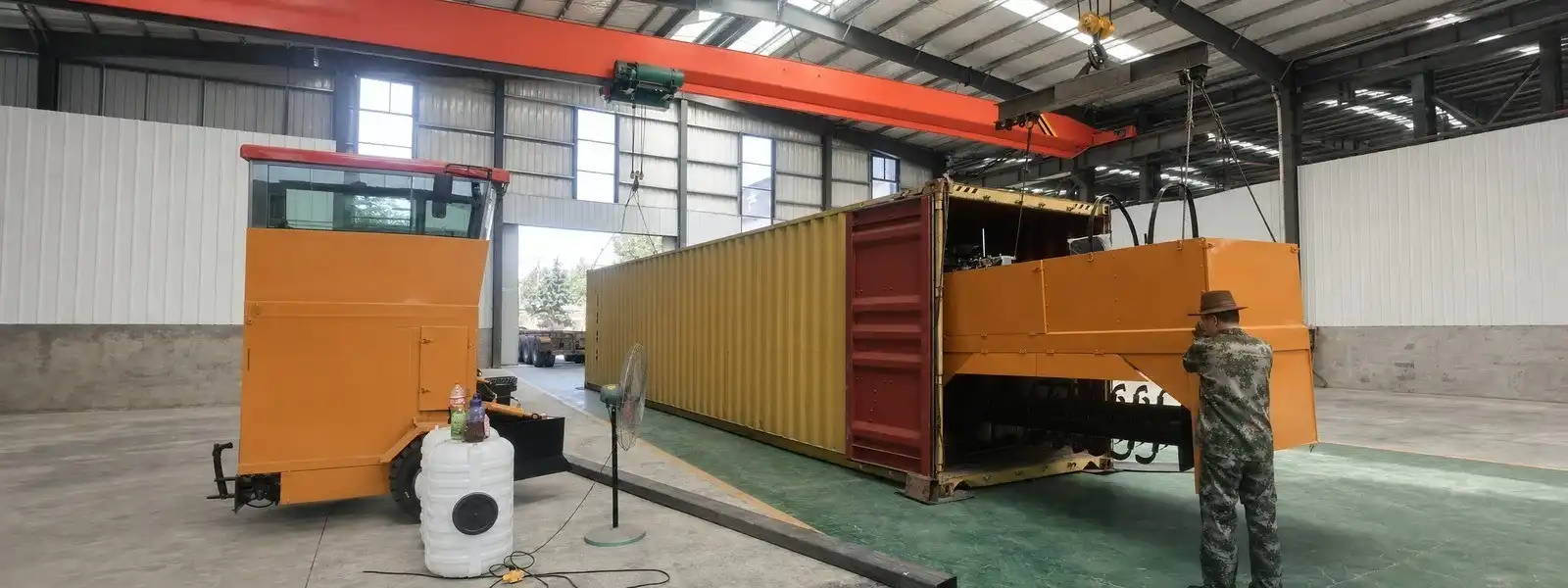
To ship big composting equipment internationally, you need to know how to load open-top and 40GP containers. YUXING makes custom loading plans that make the best use of containers and keep equipment safe while it's in transit. This is especially helpful for buyers in Ethiopia, Uzbekistan, or Peru, where getting goods from the port to the job site can be tricky. The YXFD-2600 is 2,700 mm long and 3,900 mm wide. These are the measurements that YUXING's transportation team takes into account in every plan for an export package.
Conclusion
What time and gravity can't do fast enough can be done by a crawler compost turner. It changes months of slow decomposition into a 7–15 day aerobic cycle by combining a stable crawler chassis with a high-torque rotating drum. This adds oxygen, moves moisture around, and rebuilds the pile structure all in one continuous pass. The YXFD-2600 is a reliable and field-tested choice for medium- to large facilities that care about compost quality and operational efficiency. It has CE and ISO certification, an 85 kW diesel power plant, and the ability to process up to 1,000 m³/h.
FAQ
1. How often should a tracked compost turner be serviced?
After every shift, the drum and tracks must be cleaned every day. Key moving parts should be oiled once a week, the hydraulic pressure should be checked every 250 hours of use, and a full mechanical inspection should be done every 500 hours. Unplanned downtime is kept to a minimum by sticking to this schedule.
2. Can this equipment handle moisture content above 60%?
Yes. The shape of the high-torque drum breaks up wet, thick clumps well. Adding thickening agents like straw or wood chips to high-moisture dung improves air flow and keeps the drum from getting too full.
3. What is the fuel consumption rate?
In modern hydraulic systems, the amount of power used is changed based on the resistance of the piles. Depending on the pile density and working speed, you can expect to use between 15 and 35 liters per hour.
4. Is a tracked turner suitable for smaller operations?
The YXFD-2600 is designed for medium- to big facilities that make a lot of output every day. A small tractor-mounted turner may be a better deal for businesses that process less than 100 m³ per day.
Get a Custom Quote from YUXING—Trusted Crawler Compost Turner Manufacturer
YUXING has been making fertilizer tools for more than 20 years and brings that knowledge to every job. Our team customizes solutions based on your site's layout, daily throughput, and available power sources, whether you need a single YXFD-2600 crawler compost turner or a full organic fertilizer production line. We provide CE/ISO-certified equipment, expert help 7 days a week, and quick delivery of spare parts. To get a full price right away, email us at yuxing@hnyxmachinery.com to request a detailed quote today.
References
1. U.S. Environmental Protection Agency. Biosolids Technology Fact Sheet: Composting of Biosolids. EPA, 2002.
2. Rynk, R. (Ed.). On-Farm Composting Handbook. Northeast Regional Agricultural Engineering Service, 1992.
3. Haug, R. T. The Practical Handbook of Compost Engineering. CRC Press, 1993.
4. Sánchez-Monedero, M. A., Roig, A., Paredes, C., & Bernal, M. P. "Nitrogen transformation during organic waste composting by the Rutgers system and its effects on pH, EC, and maturity of the composting mixtures." Bioresource Technology, 2001.
5. Tiquia, S. M., & Tam, N. F. Y. "Elimination of phytotoxicity during co-composting of spent pig-manure sawdust litter and pig sludge. "Bioresource Technology, 1998.
6. International Organization for Standardization. ISO 9001:2015 Quality Management Systems — Requirements. ISO, 2015.

USER EVALUATE
Get your tailored fertilizer plant solution — contact us today.