




How do you select the right organic fertilizer production line for your factory?
Selecting the right organic fertilizer production line starts with matching your factory's actual throughput goals, raw material profile, and budget against what each equipment configuration can deliver. For operators planning a large organic fertilizer production line, this means evaluating capacity (typically 6–10 t/h or higher), process flow completeness—from feeding through packing—automation level, and long-term supplier support. Getting these factors right from day one prevents costly retrofits, compliance failures, and inconsistent product quality down the road.
Understanding Your Factory's Production Needs
You need to have a good idea of what your factory needs before you look at different equipment catalogs. Every choice that comes after will be based on the answers to three basic questions.
How Much Can Your Raw Material Supply Support?
The most you can produce each day is limited by the material you have access to. This could be animal manure, crop straw, mushroom waste, or food industry waste. Running a 10 t/h line on a feedstock supply that can only handle 4 t/h adds extra work that doesn't need to be done. The FAO says that just raising livestock creates more than 5 billion tons of organic waste every year. This means that logistics and processing capacity are more often than not the problem than supply.
What Is Your Target Output Format?
Some markets need organic fertilizer that is mixed into a powder to be spread directly on the land, while others need solid organic fertilizer to be packed up for sale. This difference tells you which steps of the process you need. Feeding, grinding, screening, and packing are all part of a powder line. With a granular line, you can mix, granulate, and dry the material. When you pick the wrong format, you lose money on tools that you either don't need or will have to buy later.
What Are Your Energy and Compliance Constraints?
In Africa, Southeast Asia, and Central Asia, where grid standards range (380V, 440V, and 480V), power source compatibility is very important. When equipment can't be set up to work with the local power, it slows down installation and poses a safety risk. Many of these areas are tightening their environmental rules, so buying energy-efficient tools from the start will save you money in the long run.
Evaluating Key Components and Technologies in Organic Fertilizer Production Lines
Once you know how much you need to make, the next step is to look at the tools. Not every crusher, screener, or packer works the same way with all types of raw materials and amounts of wetness.
Crusher Type Matters More Than You Think
When the wetness level is between 25 and 45%, vertical shaft crushers work better than chain crushers with stiff and mostly dry organic materials. For instance, the YXFS-800-LS Vertical Crusher can crush 6–10 t/h at 37 kW, which makes it perfect for medium-sized powder fertilizer plants that process composted manure or farm waste. If you match the type of crusher to the material you're feeding it, you can avoid blockages and schedule maintenance less often.
Screening Precision Determines Product Consistency
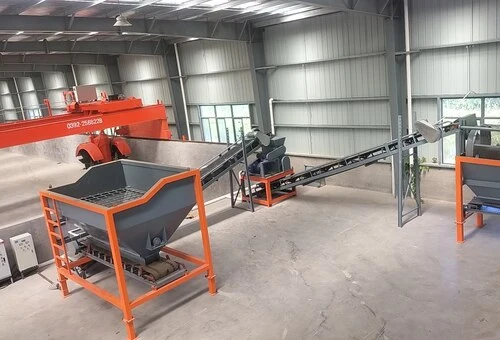
Before packing, a drum screening machine like the YXSF-4012 sorts final powder from particles that are too big or too small. This makes sure that all of the particles in the bag are the same size. This step directly affects the uniformity of the nutrients in powdered organic fertilizer, which is a quality indicator that premium buyers and farm groups are asking for more and more. The YXSF-4012 can handle 6–10 t/h and works well with a 600 mm belt conveyor system to keep the production line moving, making it a practical component to consider when planning a large scale fertilizer line.
Automation Level Affects Your Labor Budget
PLC-based control systems cut down on the need for manual work and mistakes when packing and counting. The YXBZ-50 Single Weighing Packing Machine can fill 200 to 300 20–50 kg bags an hour, which is the same amount of work that four to six people would have to do by hand. For factories in places where the cost of labor is going up, this automation usually pays for itself in less than 18 months.
Market Comparison and Supplier Selection Criteria
There is a big and wide market for tools for making organic fertilizer lines. It saves time and keeps your money safe to know how to tell the difference between trustworthy providers.
Certifications Are Non-Negotiable for Export Projects
CE and ISO approvals aren't just nice-to-haves; they're often legal requirements for equipment that works in regulatory markets affected by Europe and government-backed farming projects. They also show that the equipment has been tested for safety and quality by a third party. Before signing any procurement agreement, you should always ask for proof of the certificate.
After-Sales Support Determines Operational Continuity
A supplier who doesn't show up after delivery creates a big risk for production. Check to see if a seller provides on-site installation help, online troubleshooting, and a guaranteed supply chain for spare parts. YUXING offers lifetime after-sales service, including engineer-assisted foreign installation and video-guided commissioning. This is a big advantage if your plant is in Kazakhstan, Nigeria, or Vietnam.
Customization Capability Matches Equipment to Local Conditions
Standard tools don't always work in non-standard places. Voltage adaptation, electrical component brand choice (Siemens, Schneider), HMI language configuration, and OEM branding are all things that reliable large organic fertilizer production line suppliers offer. With these choices, the production line can fit right into your current building without needing any expensive modifications.
Decision-Making Framework for Selecting Your Production Line
Taking a structured approach to buying things will help you avoid making choices based on price alone, which is what fertilizer plant operators usually regret after the fact.
Anchor Your Decision in Verified Capacity Numbers
Do not just ask for claimed specs; also ask for test results. You should test a line that can handle 6–10 t/h against materials that are close to the ones you use as fuel. The YUXING Medium Powder Organic Fertilizer Production Line (6–10T/H) uses the YXLC-3020 Loader Feeder, which has a verified feed capacity of 3–12 t/h. This gives operators the freedom to adapt to changes in seasonal feedstock and provides a practical reference when evaluating a large organic fertilizer production line.
Assess Total Project Cost, Not Just Equipment Price
The real cost of a production line includes freight, clearing customs, preparing the base, installation workers, commissioning, and training for the operators. YUXING keeps basic equipment in stock so it can be sent out quickly. However, it takes 15–20 days to make customized setups. These dates should be included in your project schedule, especially for agricultural projects that are contracted by the government and have set due dates.
Plan for Scalability From Day One
If you buy a line that can only handle what you need now, you won't be able to grow without replacing it completely. If the market changes from wanting powder output to wanting pellet output, you can add a grinding part later on with a modular design. This gives you the freedom to protect your initial capital while keeping the costs of future growth low.
Future Trends and Innovations in Organic Fertilizer Production
Most business owners don't realize how quickly the organic fertilizer industry is changing. Two things are changing how people decide what equipment to buy.
IoT and Data-Driven Process Monitoring
Smart sensors and real-time production dashboards are being used in fertilizer operations on a medium- to large scale, as they are in large industrial plants. With these tools, workers can find changes in moisture levels, drops in output, or mistakes in packing before they become expensive problems that need to be fixed.
Circular Economy Integration
In Brazil, Indonesia, and Kenya, facilities that turn trash from cities or farms into approved organic fertilizer products are getting help from their governments. Your factory can get these subsidy programs and preferred supplier lists if it has equipment that meets environmental emission standards for things like controlling dust, getting rid of smells, and managing wastewater.
Modular Line Design for Future Upgrades
Manufacturers of equipment that are modular make it possible to add capacity or process stages without having to replace old assets. This method expands the return on investment (ROI) of tools and lowers the cost of expanding production to meet growing market needs.
Conclusion
Picking the best organic fertilizer production line will impact the quality of your factory's products, its costs, and its ability to make money in the long run. It's important to make sure that your production line fits your raw material supply, target product format, local power standards, and growth plans. If it doesn't, you'll be creating problems that won't go away. Your facility can turn large amounts of organic garbage into consistent fertilizer that is ready for sale if you have the right tools and a large organic fertilizer production line that matches your processing needs, along with a source that stays in touch after delivery.

FAQ
1. How long does delivery and installation typically take?
Standard tools for making organic fertilizer are kept on hand and can be sent out fast. There is usually a 15–20 day production lead time for customized configurations. Installation times on-site depend on the size of the project, but video help from afar can start as soon as the goods are delivered.
2. How do I evaluate energy efficiency before buying?
Ask how many kW are needed to make one ton of output. The YXFS-800-LS Vertical Crusher uses 37 kW to process 6–10 t/h, which is about 3.7–6.2 kWh per ton and is a good standard for medium-sized powder lines.
3. What maintenance practices extend equipment lifespan?
The three most important upkeep jobs are regularly greasing the crusher's bearings, checking the drum screen mesh for wear, and calibrating the packing machine's scale. As part of its lifetime service promise, YUXING provides full maintenance documentation and advice on spare parts.
4. Can the same line produce both powder and granular fertilizer?
A granulation section can be added to a normal powder line to make it bigger. Depending on what the market wants, the modular design lets you either package the powder after screening it or send it to a granulator.
Partner With YUXING for Your Next Organic Fertilizer Production Line
YUXING is a committed company that has been making large organic fertilizer production lines for more than 20 years and has customers in more than 50 countries. Our Medium Powder Organic Fertilizer Production Line (6–10T/H) is CE and ISO certified, and we offer expert help 24 hours a day, seven days a week. Our engineering team is ready to help you whether you need a standard setup or a fully customized organic fertilizer production line for sale that fits your local rules and materials. You can email us at yuxing@hnyxmachinery.com to get a free consultation and project proposal.
References
1. Food and Agriculture Organization of the United Nations. World Fertilizer Trends and Outlook to 2022. FAO, 2019.
2. International Fertilizer Association. Fertilizer Outlook 2023–2027. IFA, 2023.
3. Sommer, S.G., et al. "Nutrient Loss from Manure Management." Journal of Agricultural Science, 2013.
4. United Nations Environment Programme. Global Waste Management Outlook. UNEP, 2015.
5. Huang, G.F., et al. "Effect of C/N on Composting of Pig Manure with Sawdust." Waste Management, 2004.
6. World Bank Group. Enabling the Business of Agriculture 2019. World Bank, 2019.

USER EVALUATE
Get your tailored fertilizer plant solution — contact us today.