




What Every Farmer Needs to Know About Compost Turning Equipment
If you manage a livestock farm or run an organic fertilizer operation, compost turning equipment is one of the most important investments you can make. The right machine transforms raw manure and organic waste into finished compost in as little as 7 to 15 days — compared to the months it takes through passive decomposition. This guide walks you through equipment types, selection criteria, maintenance habits, and procurement strategy so you can make a confident, well-informed buying decision.
Understanding Compost Turning Equipment and Its Benefits
Large industrial companies are no longer the only ones that can use machines to compost. Medium-sized businesses all over the world are using trough-type and windrow turners to make regular compost that is ready for sale, cut down on labor costs, and get rid of smells.
How Mechanized Turning Accelerates Fermentation
Anaerobic bacteria produce methane, hydrogen sulfide, and bad smells when organic matter sits without being stirred. Turning the pile by hand on a regular basis adds air, which turns on aerobic bacteria that make heat above 55°C (131°F). The US EPA says that pathogens are reduced to safe levels when this temperature is maintained for at least three days in windrow systems. Mechanized turning makes sure that every part of the pile meets that standard.
Key Benefits for Farm Operations
Moving from managing piles by hand to using a trough turner improves quality, compliance, and labor. Here are the main benefits that medium-sized businesses always say they have:
- Reduced fermentation time: Mechanical aeration cuts composting cycles from 3–6 months down to 7–15 days, freeing trough space for the next batch.
- Labor cost reduction: One operator running a machine like the YXFP-3000 can process over 200 m³ per hour — work that would otherwise require a crew of six to eight people with hand tools.
- Consistent compost quality: Even mixing distributes moisture, microbial inoculants, and nutrients throughout the pile, producing a uniform end product suitable for organic fertilizer production.
- Odor and emission control: Proper aeration suppresses anaerobic decomposition, directly addressing neighborhood odor complaints and reducing greenhouse gas output.
Mechanical aeration shortens the fermentation process, which frees up space in the trough for the next batch by cutting the time it takes to compost from 3 to 6 months to 7 to 15 days.
Energy Consumption Considerations
These benefits directly lead to lower running costs and higher compost value per ton. This is why the global market for composting equipment was worth about USD 6.2 billion in 2022 and is still growing at a steady rate.
Types of Compost Turning Equipment and Choosing the Right Machine
By learning about the different types of tools that are out there, you can find a machine that fits your site's plan, waste volume, and budget.
Windrow Turners vs. Trough Turners
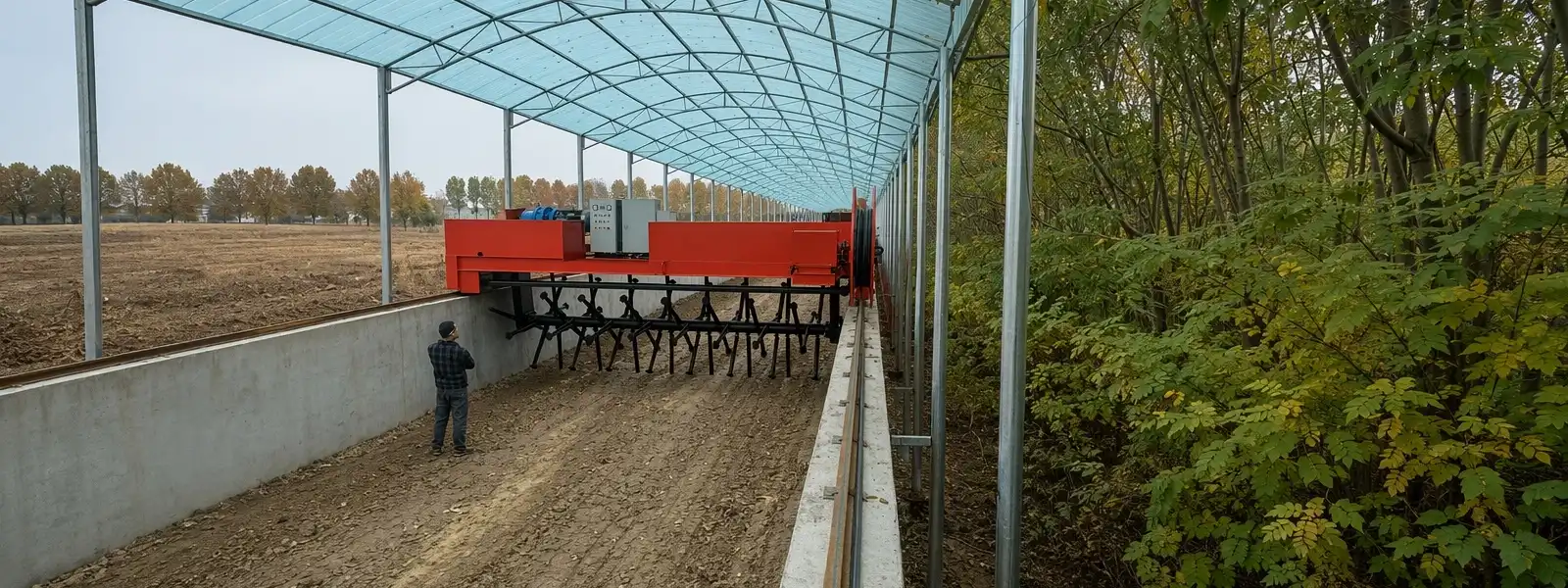
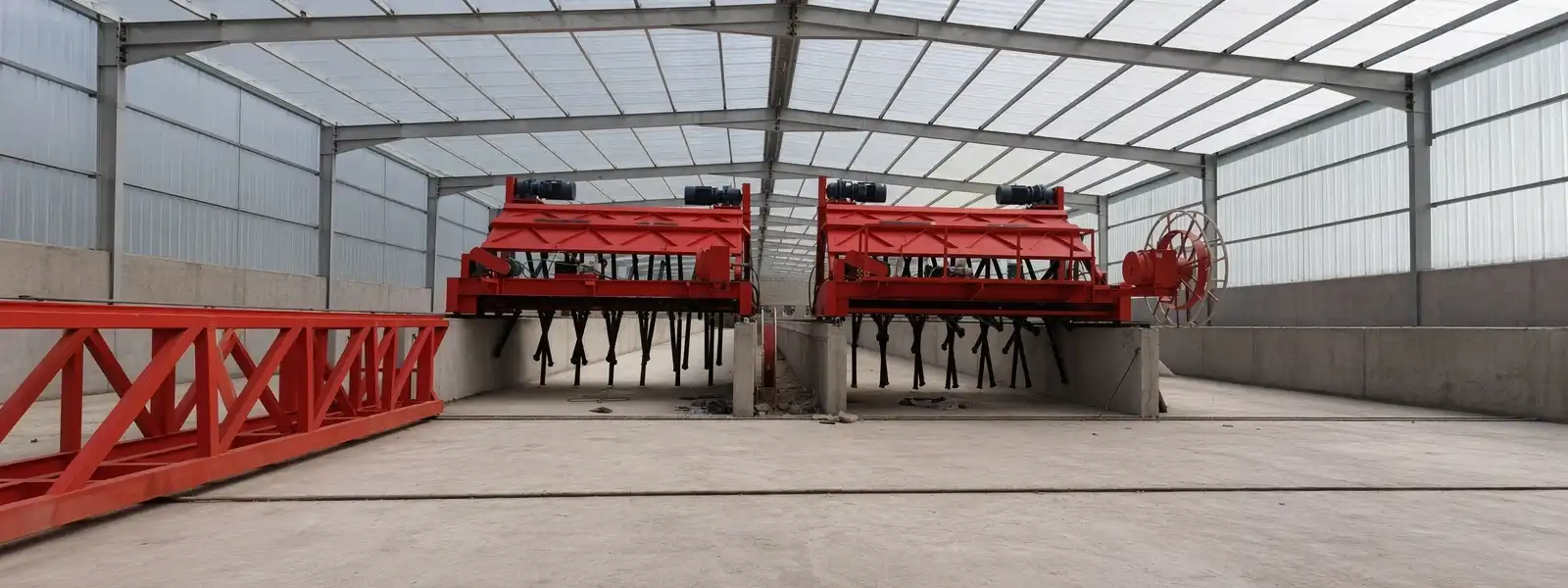
Open-air compost rows are crossed by self-propelled windrow turners, which work well on big outdoor sites without set infrastructure. Trough-type (groove-type) turners move along concrete fermentation channels and work best inside or under a roof, where keeping smells down and making the best use of space are important. People who make fertilizer on a medium scale usually choose trough models with a working width of 3,000 mm, like the YXFP-3000, as a practical form of compost turner equipment.
Electric vs. Diesel Power Sources
Electric cars need a stable power grid, but they use less gas and are easier to maintain. Diesel units are mobile and don't depend on electricity, which makes them useful for animal farms that are far away in places like Sub-Saharan Africa or Central Asia where the dependability of the power grid isn't always reliable. One of the first things you should look at before you buy is the power supply in your area.
Matching Capacity to Daily Waste Volume
A cow feedlot that makes 50 tons of manure every day needs a machine that can handle that much within an acceptable time frame every day. Having a turning width of 3,000 mm and a turning height of 0.8–1.2 m, the YXFP-3000 can produce up to 200 m³/h. It can move at speeds between 1 and 10 m/min, so operators can control how much material it moves based on its density and moisture content.
Maintenance and Best Practices for Optimal Compost Turning Efficiency
A well-kept machine saves your investment and keeps you from having to pay for expensive downtime when trash production is high.
Routine Inspection and Lubrication Schedule
Check the moving teeth or blades every 500 hours of use, especially when working with rough materials like chicken litter that has a lot of sand in it. High-manganese steel teeth last longer in manure environments that are corrosive. Follow the manufacturer's instructions for how often to grease all the bearing points and chain drives. For machines like the YXFP-3000 that use a double-row 20A chain and sprocket transmission, chain tension should be checked once a week while the machine is running continuously.
Hydraulic System Care
Clean oil with the right thickness is needed for hydraulic lifting equipment. When fermentation takes place in places with high temperatures, the heat thins the oil, which speeds up seal wear. Check the viscosity of the oil every three months and replace the hydraulic filters every 250 to 300 hours of use. A lot of hydraulic parts in composting equipment break down because someone forgot to do this one repair item.
Monitoring Pile Conditions
For composting to work, the moisture level needs to be between 50 and 65%. When materials are above 70%, they tend to clump together and stop oxygen from flowing. At this point, you should add thickening agents like straw or sawdust before turning. Every day, check the temperature inside the pile. If the temperature drops below 45°C, turn the wheel more often. Keeping a simple record of temperature, moisture, and times of turning can help you find problems quickly and show that you're following EPA and state environmental rules.
Comparing Compost Turning Equipment: Making an Informed Procurement Decision
When picking between suppliers and models, you need to look at performance data, certification status, and long-term support with fresh eyes.
Mechanized vs. Manual Composting
It costs about USD 8–12 per ton just for the labor to turn something by hand using front-end loaders or hand tools. At medium scale, a mechanized trough turner with a capacity of 200 m³/h or more can usually bring that price down to less than USD 2 per ton. Along with being more expensive, hand methods make it hard to keep the depth and frequency of aeration constant, which has a direct effect on how mature the compost is and how many pathogens it kills. Using a compost turning machine can help provide more consistent mechanical turning and aeration at medium scale.
The YXFP-3000: A Closer Look at Specifications
The YXFP-3000 One-machine Whole-trough Compost Turner is made for medium-sized businesses that need steady, reliable throughput. Its main design elements are worth taking a close look at:
- Drive system: Two 15 kW motors drive both ends of the turning shaft, supported by two cycloidal pinwheel reducers for balanced torque distribution.
- Travel system: Eight 290 mm cast steel travel wheels provide stable movement across concrete trough surfaces, with speed adjustable from 1–10 m/min via a 2.2 kW speed-regulating motor.
- Multi-trough transfer: The included transfer car (2.2 kW) allows a single machine to serve multiple fermentation troughs, lowering equipment investment per unit of capacity.
- Control method: Both manual and remote control modes are available, reducing operator exposure to ammonia-heavy environments.
Because of these design choices, one person can run a multi-trough composting facility that used to need a whole team of workers. The machine has CE and ISO certifications and a lifetime 7x24 after-sales guarantee that includes help with setup, help with operation, and extra parts.
Evaluating Supplier Credibility
When choosing a compost turner provider, make sure to ask for proof of CE/ISO certification, customer references from people who have bought compost turners in similar temperatures or with similar kinds of trash, and information on how long it takes to get extra parts. YUXING has been making fertilizer equipment for more than 20 years and has customers in more than 50 countries. Standard equipment can be shipped right away, but custom configurations need 15–20 days to be made.
Where and How to Purchase Compost Turning Equipment
Procurement Channels and Price Benchmarks
Buyers on a tight budget who want to spend between USD 3,000 and USD 35,000 can get tools straight from manufacturers, through B2B platforms, or through area distributors. When you buy directly from the manufacturer, you usually get better prices, more customization options, and faster technical support. Spend between USD 15,000 and USD 30,000 on medium-sized trough turners with a working width of 3,000 mm. This will depend on the motor configuration and the inclusion of a transfer car.
Logistics and Customs Planning
The 40GP or Open Top containers are used to move big trough turners. YUXING offers professional container packing plans that are made to fit the size of your equipment, as well as export wrapping that is perfect for long-distance ocean freight. For parts that are too big to ship, modular disassembly options are available to meet the rules in the countries where the goods are going.
Customization Options
YUXING offers full ODM/OEM customization, which includes changing the voltage and power supply, choosing the brand of electrical parts (Siemens, Schneider), controlling PLC automation, setting the language of the operating interface, and making sure that the product meets CE certification standards. This means that Yuxing can meet the needs of buyers in Vietnam, Kenya, Brazil, or Uzbekistan.
Conclusion
Picking the correct recycling machine will impact your business's product quality, labor costs, and environmental compliance for many years to come. Medium-sized farmers can use trough-type turners like the YXFP-3000 to turn raw manure into organic fertilizer that is ready to sell in 7–15 days. Choose a seller with a track record of good after-sales service and make sure the compost turning equipment you buy can handle the amount of trash you produce every day. That mix saves your investment and keeps your business running during times of high production.
FAQ
1. How often should I turn compost in a trough system?
For active oxygen fermentation, turn the pile every one to two days for the first week. After that, every three to four days should be enough to keep the temperatures stable. When animal waste is added to this plan, the compost is usually ready in 7–15 days.
2. Can commercial-grade trough turners handle moisture above 70%?
Yes, but the performance is much better when you add bulking agents like sawdust or straw to lower the moisture level to below 65%. This keeps the material around the turning teeth from packing down, which would stop airflow through the pile.
3. Should I choose a crawler-type or wheel-type machine?
Wheel-type turners, like the YXFP-3000, work best on concrete troughs that are smooth and paved. Crawler-type machines are better at going over rough or loose ground, but they tend to be larger and cost more to keep.
4. What certifications should I require from a compost turner supplier?
Ask for at least CE certification (needed for EU markets and accepted around the world) and ISO 9001 quality management certification. These papers prove that the product and the way it was made both meet standards that are known around the world.
Get a Direct Quote from YUXING — Trusted Compost Turning Equipment Manufacturer
More than 50 countries have bought organic fertilizer equipment from YUXING in the last 20 years. The YXFP-3000 compost turning equipment is CE and ISO certified, ships from stock, or has a 15–20-day wait time for custom setups. It also comes with a 7x24 lifetime warranty. You can email our team at yuxing@hnyxmachinery.com to get price information, specs, and advice on how to set up your site properly. Our techs are ready to help you choose the best machine for your trough size and the work you need to do every day.
References
1. U.S. Environmental Protection Agency. Biosolids Technology Fact Sheet: Land Application of Biosolids. EPA, 2000.
2. Rynk, R. (Ed.). On-Farm Composting Handbook. Natural Resources, Agriculture, and Engineering Service, 1992.
3. Haug, R. T. The Practical Handbook of Compost Engineering. Lewis Publishers, 1993.
4. Grand View Research. Composting Equipment Market Size, Share & Trends Analysis Report. Grand View Research, 2023.
5. Bernal, M. P., Alburquerque, J. A., & Moral, R. "Composting of animal manures and chemical criteria for compost maturity assessment." Bioresource Technology, 2009.
6. Food and Agriculture Organization of the United Nations. Livestock's Long Shadow: Environmental Issues and Options. FAO, 2006.

USER EVALUATE
Get your tailored fertilizer plant solution — contact us today.