



_1782098484336.webp)
How to Start a Small Organic Fertilizer Production Line
Starting a small organic fertilizer production line is one of the most practical ways to convert agricultural waste into steady revenue. Whether you manage a livestock farm, run an agricultural cooperative, or want to launch a fertilizer startup, a compact production system lets you process raw organic materials—manure, crop residue, and food waste—into marketable powder or granular fertilizer. With the right equipment configuration, a small organic fertilizer production line can handle 4–6 tons per hour while keeping startup costs within a $20,000–$300,000 range. This guide walks you through everything you need to get started.
Understanding the Basics of Small-Scale Organic Fertilizer ProductionWhat Goes Into an Organic Fertilizer Line?
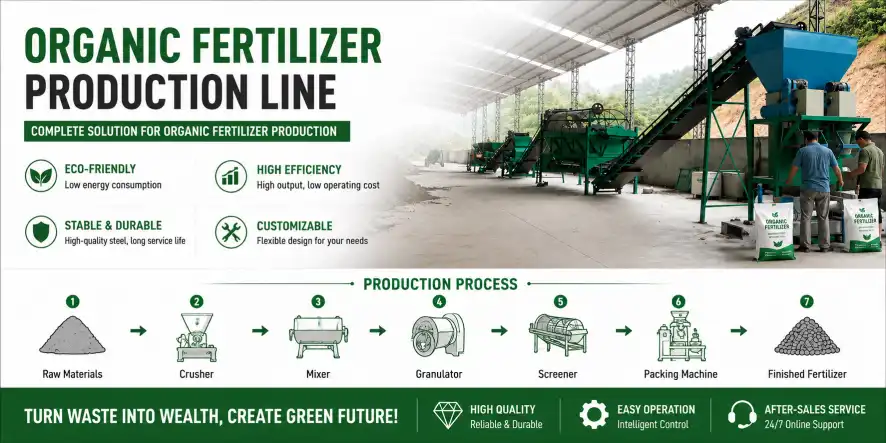
A good method for making organic fertilizer has several important steps: preprocessing the raw materials, crushing, screening, and, if needed, granulating and packing. Animal waste, pig waste, cow dung, farm straw, and organic sludge are some examples of raw materials. These things move in a certain order along the line, and each stage has a specific job to do, such as removing moisture, making sure particles are all the same size, keeping nutrients safe, and showing off the finished product.
The process is easier to follow for small businesses that want to make powder fertilizer. For instance, the YUXING 4–6T/H Small Powder Line works like this: feeding → conveying → crushing → screening → conveying → packing. This lean process keeps energy use low while keeping the quality of the output stable.
Why Powder Lines Make Sense for Startups?
Powdered organic fertilizer doesn't need as many steps in the processing process as powdered fertilizer, which means lower equipment costs and easier use. Powder lines are easy for farmers and small groups in Nigeria, Vietnam, Indonesia, and Peru to use because operators don't need much training. A well-set-up automatic line can be run by two or three people for the whole shift.
Step-by-Step Guide to Setting Up Your Production Line
Setting up correctly from the start will save you time, money, and problems with how things work in the future. The steps below are easy to follow.
- Site selection is more important than most new creators think. Your building needs to have enough floor space, a reliable three-phase power supply that can work with 380V, 440V, and 480V, and easy logistics access for delivering raw materials and sending out finished goods.
- Raw material preprocessing determines the quality of the final product. If the materials you're working with have more than 50% water, you need to dewater them first with a screw press or rotary dryer. Getting the moisture level to between 30 and 40 percent ensures that the crusher and screen can work at full capacity without getting clogged.
- Equipment installation and commissioning of the small scale fertilizer line should follow the supplier's plan diagram. For clients in other countries, YUXING offers full installation guidance, including video support and sending an engineer to the site. The YXDK-50 Control System centralizes operation management, which cuts down on manual work and lets workers keep an eye on every step of the production process from a single panel.
- Capacity planning should be in line with the raw materials you have on hand. The 4–6T/H setup works well for farms that make 30–50 tons of organic garbage every week and for businesses that want to sell fertilizer in their local or regional markets.
Comparing Production Solutions: Making an Informed Choice
Powder vs. Granular: Which Fits Your Business?
Powder lines are easier to get started with and take less time to set up. Granular lines make a better product that costs more, but they need extra equipment like granulators, dryers, and coolers, which increases the cost of capital and the difficulty of running the line. The powder route is a faster way for startups with little money to make money.
Manual vs. Automated Operation
Processing things by hand leads to uneven quality and high ongoing labor costs. An automatic line like YUXING's 4–6T/H Small Powder setup keeps output consistent and lowers the risk of mistakes made by people. With the YXDK-50 Control System, operations can be partially automated, which lets small teams reliably oversee production.
Here are the core specifications that differentiate this line from fragmented, manual setups:
- Crushing Equipment: The YXFS-600-LS vertical crusher can handle 4–6 T/H of material and is designed for continuous processing of organic materials.
- Screening Equipment: YXSF-3012 Drum Screening Machine, which can handle 4–6 T/H and makes sure that the particles are all the same size so that the quality of the fertilizer stays high.
- Conveying System: 600 mm-wide belt conveyors moving at 1.3 to 1.6 m/s to keep the flow of materials smooth and steady.
- Packing Equipment: Powder Packing Scale for precise, market-ready packing in a small scale fertilizer line.
- Certifications: CE and ISO certifications are required for foreign markets and to meet government rules.
These requirements work together to get rid of the quality problems that come up with manual or piecemeal processing. A system that is made for ongoing output rather than batch-by-batch improvisation is better for the operators.
Maintenance, Troubleshooting, and After-Sales Support
Keeping Your Line Running Long-Term
Your return on investment is directly protected by regular repair. There are three time periods that make up an organized approach: daily checks on belt tension, conveyor alignment, and dust seals; weekly checks on the crusher blades and screen mesh to make sure they are in good shape; and monthly checks on the electrical connections and control system calibration.
Under normal conditions, wear parts like crusher blades and screen panels usually last between 12 and 18 months. When you use heat-treated high-manganese steel, repair intervals are extended by about 20%, which cuts down on unnecessary downtime.
YUXING guarantees every installation for life, 7 days a week, 24 hours a day. This includes help with installation, fixing problems during use, advice on spare parts, and remote technical support. On-site engineers can be sent to clients in Africa, Southeast Asia, Central Asia, and South America when remote support isn't enough. A reliable supplier is different from a transactional equipment vendor because they offer this level of service continuity.
Procurement and Investment Considerations for B2B Buyers
Total Cost of Ownership and Financing Options
A production line's real cost is higher than the price of the tools it uses. Buyers should think about the costs of shipping, clearing borders, installation work, training for operators, and keeping extra parts on hand. YUXING's turnkey project model combines these parts into a single, doable contract. This makes it easier for buying teams that work in different time zones to coordinate.
Budget advice: the 4–6T/H small powder line costs between $20,000 and $80,000, based on how it is customized. This means that farms and groups with limited funds can buy it. Supplier credit, machine leasing, or farm development loans are all ways to get money that can lower your upfront risk even more.
There are a lot of reasons why new equipment from a CE/ISO-certified producer is better than used equipment: performance data is recorded, there are warranties, compatible spare parts are easy to find, and the equipment meets foreign market standards. YUXING keeps standard equipment in stock so that it can be sent out quickly. Customized configurations are delivered within 15–20 days.
Conclusion
In conclusion, you can start a small-scale organic fertilizer business if you have the right tools, prepare the land well, and work with a source. The 4–6T/H powder production plan is a simple and cost-effective way for farms and groups to start with a small organic fertilizer production line and turn organic waste into commercial fertilizer. With CE/ISO-certified equipment, automated control systems, and lifetime support after the sale, YUXING takes care of everything, from receiving raw materials to sending out finished goods in packages. Right now is the best time to start thinking about your first production line or improving equipment that is spread out.
FAQ
1. What raw materials can a small powder line process?
Chicken poop, pig waste, cow dung, crop straw, and organic sludge are all common sources. Before they can be crushed, materials that are more than 50% wet need to be dried out first.
2. How long do installation and commissioning take?
Standard equipment can be sent out quickly from stock. Depending on how ready the site is and the equipment in the area, on-site commissioning usually takes 7–15 days. YUXING gives advice on installation and can send workers overseas if needed.
3. What power supply is required?
Three-phase industrial power is used for the 4–6 T/H small powder line. YUXING lets you change the voltage for 380V, 440V, and 480V supply configurations so they work with the grids in South America, Southeast Asia, and Africa.
4. Can the line produce both powder and granular fertilizer?
The powder line is set up to produce the most powder. Granular production is achieved by adding a granulation module. YUXING has modular upgrade paths that protect your initial investment as your business grows.
Get Your Custom Quote from YUXING—Trusted Small Organic Fertilizer Production Line Manufacturer
For more than 20 years, YUXING has helped people in more than 50 countries in Africa, Southeast Asia, Central Asia, and South America. As a confirmed provider of small organic fertilizer production lines, we offer CE/ISO-certified equipment, full project support, and 7x24 customer service after the sale. Get in touch with our expert team right away to get a custom production plan and quote on tools. Email us at yuxing@hnyxmachinery.com.
References
1. FAO—Food and Agriculture Organization of the United Nations. World Fertilizer Trends and Outlook to 2022. FAO, 2019.
2. IFA—International Fertilizer Association. Fertilizer Outlook 2023–2027. IFA, 2023.
3. Tian, G., Franzluebbers, A.J., & Grandy, A.S. Organic Fertilizers: Sources, Components, and Uses. Journal of Plant Nutrition and Soil Science, 2021.
4. USDA — United States Department of Agriculture. Organic Agriculture: Environmental Benefits of Organic Production Systems. USDA Economic Research Service, 2022.
5. Ndegwa, P.M., & Thompson, S.A. Integrating Composting and Vermicomposting in the Treatment and Bioconversion of Biosolids. Bioresource Technology, 2001.
6. World Bank Group. Financing Agribusiness in Sub-Saharan Africa: Opportunities, Challenges, and Investment Vehicles. World Bank, 2020.

USER EVALUATE
Get your tailored fertilizer plant solution — contact us today.