



_1782098484336.webp)
How to Design an Efficient Vertical Fertilizer Fermentation Plant
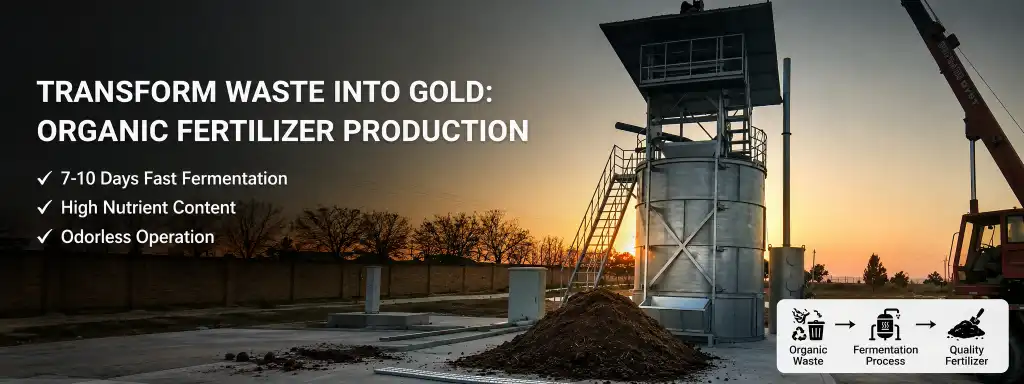
Designing an efficient vertical fertilizer fermentation plant starts with selecting the right enclosed bioreactor system that delivers consistent, high-temperature aerobic decomposition regardless of external weather. A properly configured vertical fermentation tank—like YUXING's YXYT series with volumes ranging from 32 to 160 m³—compresses fermentation cycles to 7–12 days, eliminates open-air odor exposure, and processes chicken manure, pig dung, kitchen waste, and organic sludge within a footprint as compact as 45–70 m². Getting the design right from day one directly determines your throughput reliability, regulatory compliance posture, and long-term operating cost.
Understanding Vertical Fermentation Tanks in Fertilizer ProductionWhat Makes a Vertical Tank Structurally Different?
A vertical fermentation tank is a bioreactor that is shaped like a cylinder and is sealed. It is positioned vertically along its axis. This direction naturally helps with gravitational mixing, managing thermal stratification, and installing things in a way that uses the least amount of room. With tank widths ranging from 3,600mm to 7,000mm and heights between 7,000mm and 9,000mm, the YUXING YXYT line can fit a lot of volume into a small amount of land. On the inside, the biological mass is mixed evenly by a central high-torque mixing shaft with wear-resistant metal blades.
Core Functional Principles
Microbes that are thermophilic and aerobic process food in the system. When organic trash is loaded with less than 70% water, both native and imported aerobic bacteria make metabolic heat, which raises the temperature inside to 55°C to 65°C. The EPA's composting standards, which say that temperatures must stay above 55°C for a certain amount of time to kill pathogens, weed seeds, and other harmful organisms, back up these temperature ranges. An integrated aeration network keeps the dissolved oxygen level high, and PLC-based automation checks the temperature and moisture levels in real time without needing constant human input.
Before you start planning the layout of your plant, finding materials, or buying equipment, you need to understand these basic ideas.
Key Principles for Designing an Efficient Vertical Fertilizer Fermentation Plant
Right-Sizing Your Tank to Match Waste Generation
Mismatching tank volume to daily input volume is the most common design mistake in facilities that handle organic garbage. The YXYT series from YUXING can handle daily processing capacities of 2 to 18 m³, making it suitable for medium-sized farms that raise animals, municipal solid waste centers, and organic fertilizer plants. The YXYT-120 model would work well for a cow farm that makes 8 m³ of manure every day, while the YXYT-32 model would work better for a smaller chicken farm that makes 2–3 m³ of manure every day.
In addition to size, three other factors define how efficient a plant is:
- Thermal retention design: The double-layer polyurethane insulation jacket keeps the temperature inside the vertical compost tank at a steady -20°C even when the outside temperature drops. This means that the system can be used reliably in cold places like Eastern Europe and Central Asia without having to pay extra for heating.
- No auxiliary bulking materials required: Traditional composting methods need straw, sawdust, or wood chips to change the carbon-to-nitrogen ratios. The YXYT series, on the other hand, can directly load chicken manure, cow dung, kitchen waste, and organic sludge—reducing the costs and complexity of moving the materials.
- Continuous operation mode: The system is in continuous fermentation mode, which means that new material comes in from the top and stable output flows out of the bottom. This keeps the daily rate steady and prevents group processing bottlenecks.
These three design concepts add up to a clear return on investment for operations. A livestock farm in Vietnam that used a similar enclosed aerobic system said that they used over 80% less land for waste treatment than they did with their old open windrow system, and they met provincial standards for odor emissions within six months of starting up the system.
Comparing Vertical vs. Horizontal Fermentation Tanks for Fertilizer Production
Space and Thermal Efficiency Trade-offs
Horizontal fermentation tanks spread their volume out over a larger floor space, which makes them harder to place in tight spaces. A horizontal unit that can handle 120 m³ of material may take up three to four times as much space on the ground as a vertical fermentation tank of the same size. Vertically oriented systems use the height of the building instead of the floor area, making them better for places where land is expensive or where environmental regulations make it hard to grow.
In terms of thermal efficiency, a vertical shape lowers the ratio of surface area to volume, which means that less heat is lost through the walls of the tank. When combined with polyurethane insulation layers, this shape keeps the energy use for YUXING's YXYT models at about 15–25 kWh per ton of processed waste, which is about the same as the energy use for top-sealed composting systems that are used as standards in the industry.
Horizontal systems make it easier to get to large-diameter auger systems mechanically, but they also make maintenance more difficult around horizontal shaft bearings that are subjected to heavy organic loads. When evaluating a vertical fertilizer fermentation plant design, vertically oriented mixing assemblies can offer advantages because they are made with hard-facing alloy blades and usually last longer than 10 years with regular maintenance.
Selecting Materials and Components for Vertical Fertilizer Fermentation Tanks
Why Interior Lining Material Is Non-Negotiable?
The air inside a vertical fermentation tank is very harsh chemically. Volatilization of ammonia, organic acids, and wetness all work together to quickly break down carbon steel that isn't secured. The YXYT series from YUXING has an inner lining made of 304 stainless steel, which is known to be resistant to acid-base corrosion over the pH range that is common for thermophilic fermentation. All load-bearing seams are checked for structural weld integrity before the equipment leaves the factory using non-destructive testing methods such as X-ray and dye penetrant inspection.
Automation and Control Architecture
Plant managers can check the temperature, air cycles, and moisture levels of the fermentation process from a single panel thanks to the combined PLC control system with an HMI interface. The voltage standards, electrical component brands, interface language, and software configuration can all be changed to fit the local infrastructure and operator skill levels. This is especially helpful for clients in Southeast Asia, Africa, and Eastern Europe, where grid standards and technical knowledge are very different.
Procurement and Installation: How to Source and Implement Vertical Fermentation Tanks?
Finding a vertical fermentation tank maker with a history of exporting greatly lowers the risk of ordering. YUXING has sold fertilizer equipment to customers in more than 50 countries. They are experts at loading containers using 40GP, open-top, and oversized equipment transport configurations. Standard types are kept in stock so they can be sent out quickly, but special versions have to be ordered 15–20 days in advance.
Installation support includes sending an engineer to the site, setting up equipment remotely with the help of videos, and giving plant staff full training on how to use the equipment. After the equipment is installed, YUXING offers lifelong technical service that includes maintaining the equipment, supplying extra parts, and improving the process. This kind of commitment sets a long-term equipment partner apart from a transactional provider.
Procurement teams that are watching their budgets should know that YUXING's YXYT series can be bought for between $15,000 and $80,000, which means that medium-sized businesses can use it without giving up industrial-grade construction quality.
Conclusion
Making a good vertical fermentation tank plant requires careful choices at every step, from the shape and size of the tanks to the materials used, the way the automation is set up, and how reliable the suppliers are. The main problems with open composting are that it depends on the weather, doesn't control smells, takes up too much space, and doesn't always kill pathogens. Vertical sealed oxygen systems solve these problems. With a 32–160 m³ capacity range, continuous operation mode, and a small 45–70 m² footprint, YUXING's YXYT series is a technically sound and commercially viable choice for farms that raise animals, make organic fertilizer, or process municipal waste that want to update their fermentation infrastructure.
FAQ
1. How does the tank maintain fermentation temperature in cold climates?
When aerobic bacteria produce metabolic heat and high-density polyurethane insulation work together, the temperature inside stays at 60°C even when the outside temperature drops to -20°C. In normal cold-weather setups, there is no need for an outside heating system.
2. What moisture level is acceptable for input materials?
The YXYT series processes organic waste with moisture content below 70%. Extra bulking agents are not needed, but straw or sawdust can be added to deal with very high moisture levels if needed.
3. How is odor managed during fermentation?
The fully sealed tank design stops gas from escaping without being managed. Before being released into the atmosphere, all of the exhaust gases go through a built-in multistage biofilter or water-scrubbing tower, which gets rid of volatile organic compounds and ammonia.
4. What is the expected mixing component lifespan?
When the agitator blades are treated with a hard-facing metal and the main bearings are oiled on a regular basis, the mixing system is designed to last more than 10 years of constant use.
Partner with YUXING for Reliable Vertical Fermentation Tank Solutions
YUXING has been making fertilizer equipment for more than 20 years and brings that experience to every project. Our YXYT series offers proven performance, CE-certified construction, and full lifecycle technical support, making it the best choice whether you are looking for a vertical fermentation tank supplier for a new organic fertilizer plant or an upgrade to an existing waste treatment facility. You can email our tech team at yuxing@hnyxmachinery.com to get a price for a custom configuration.
References
1. Haug, R. T. The Practical Handbook of Compost Engineering. Lewis Publishers, 1993.
2. United States Environmental Protection Agency. Environmental Regulations and Technology: Control of Pathogens and Vector Attraction in Sewage Sludge. EPA/625/R-92/013, 2003.
3. Tchobanoglous, G., Theisen, H., & Vigil, S. Integrated Solid Waste Management: Engineering Principles and Management Issues. McGraw-Hill, 1993.
4. Diaz, L. F., de Bertoldi, M., Bidlingmaier, W., & Stentiford, E. Compost Science and Technology. Elsevier, 2007.
5. Huang, G. F., Wu, Q. T., Wong, J. W. C., & Nagar, B. B. "Transformation of Organic Matter During Co-Composting of Pig Manure with Sawdust. "Bioresource Technology, 2006.
6. Karak, T., Bhagat, R. M., & Bhattacharyya, P. "Municipal Solid Waste Generation, Composition, and Management: The World Scenario." Critical Reviews in Environmental Science and Technology, 2012.

USER EVALUATE
Get your tailored fertilizer plant solution — contact us today.